Wednesday, September 7, 2011

My Love/Hate Relationship with Anime.

I grew up at a very particular and unique time in geek history. When I was young, certain classic Japanese cartoons were dubbed, dumbed down a little and pushed onto American television sets with the rest of children's TV. Like most other kids of the 1980s, I grew up knowing Voltron, Tranzor Z and Robotech without any idea that the shows were made in a place called Japan. A few years later, these shows and a few other popular ones would make their way to the US under the label "Japanimation." Thankfully, by the time I was in late high school and early college, that unwieldy and vaguely racist term had faded in favor of the word "anime," and in the dorm rooms in the mid-1990s, I watched a lot of it. At the time, I'd have called myself an anime fan. I don't really wear that label today.

When I got to see this unedited and de-sanitized as Macross,
 I  gained a whole new level of respect for these shows.

With the rise of the internet happening literally before my eyes given that I was in a University with a PC Lab when the graphical world wide web was in its infancy, exposure to subcultures became easy. You didn't have to find that one weird guy who attended anime conventions or lurked on usenet newsgroups in order to find out about the scene. I was able to head to the local video store and rent taped films and episodes of series both subtitled and dubbed into english without being at the mercy of the tastes of local fansubbers and their limited command of Japanese. I watched Vampire Hunter D, Golgo 13 (since I'd played the game on the NES, why not?,) Dominion Tank Police (my first exposure to catgirls,) Ranma 1/2 and Dirty Pair. We'd hang out late into the night smoking cigarettes and eating raw cookie dough, laughing at and generally enjoying Anime when we weren't gaming or playing spades.

As years passed, in my post-college days I continued to watch various Anime series with people from my gaming groups, though most of the faces had changed since college. As a group, we went through the entire series of Evangelion, loving every minute up until the final episode that provided nothing in the way of closure and was confusing and abstract. (I'm aware of the movies that correct this, but haven't seen them.)  As D&D players, we also watched the Record of Lodoss War series, loving the first series and confused and frustrated by the second. The plot was rebooted, character motivations and personalities changed, and instead of animating the awesome fantasy battles that made the original series so much fun to watch, the characters would freeze into a tableau as they charged into combat. The fights were implied, with the results shown afterward, and the "chibi" style comedy bits at the end of the episodes provided laughs, if not satisfaction.

If you love the original series and are tempted to watch "Chronicles of the Heroic Knight,"
heed my warning and leave it alone, watching it tarnished my memory of the series.

Meeting some of the folks who were really into anime in these years gave me my first exposure to the things I didn't care for about the genre. Stories about Magical Girls, hentai (porn) with tentacled beasts raping schoolgirls, and nonsensical soap operas or adventure stories where very little seemed to actually happen. I learned about the fascination with these characters and these sorts of stories that did nothing for me, and a new generation of imported dubbed series hit US TV sets. Sailor Moon, Dragon Ball Z... I gave them both an honest shot and determined that I wasn't the target audience for this sort of thing, but the average fan of anime was rapidly becoming the sort of person who craved more of the things I liked least about the form as art and entertainment.

There were some really great things in the anime world I managed to get exposed to, the primary among those being Cowboy Bebop. Now this, I could get into. Amazing music, interesting characters, the world had a distinct "feel" that I could grasp and want to see more stories told in right away. The animation was of sufficient quality that I could tell without being told that the lead character's fighting style was specifically Jeet Kun Do, as practiced by Bruce Lee. I went through every episode of the series I could get my hands on, and made a special trip to a little art house theater downtown to catch the movie when it entered into limited release here in Chicago. I still have both the opening and closing credits compositions by Yoko Kanno and the Seatbelts in my MP3 collection. The music throughout the entire series was great, and even the english voice dub actors were decent, though I preferred subtitles.

They just don't make 'em like this anymore.

I'd have still called myself a fan, until I turned up at a few anime conventions, and added anime as one of my interests on StumbleUpon. I swiftly realized that the default perspective of the typical fan of the genre had left me behind, and was mired in stuff that I couldn't get into. Inu Yasha, Naruto, Yu Gi Oh!, and the terrible hack jobs of content editing and poor translation inflicted on shows that might have been good before they were sanitized for US audiences sickened me. I gave every one of these shows a legitimate shot, and ended up hating them. Giving credit where it is due, I did quite enjoy Fullmetal Alchemist, or what little I saw of it, and I've seen even less of Death Note, but it intrigues me a little. I've come around to looking at what anime has evolved into, and I realize that I'm annoyed by the vast majority of it.

I don't turn up at anime conventions anymore, and I watch first episodes of a series suggested to me with more than a little suspicion now. I removed "anime" as an interest on Stumble and other social media, because I found myself ignoring or even blocking 90% of what was turning up for me. I'm finished with great shows, like Samurai Champloo, Hellsing and Initial D, and I gave Bleach a shot and hated it, and I'm not sure at all what to make of Trigun or One Piece. One series that I had a lot of contempt for, but in recent years have warmed up to somewhat is Pokemon, and I catch myself humming the theme song or making jokes about "It's Super Effective!" without a hint of shame. I guess I'd just like to see a little less crude slapstick and chibi faces, and a little more thoughtfulness like the kind found in Perfect Blue, Grave of the Fireflies or Princess Mononoke. Is that kind of anime even made anymore, and I'm just missing it?
Best Blogger Tips
  • Stumble This Post
  • Save Tis Post To Delicious
  • Share On Reddit
  • Fave On Technorati
  • Buzz This Post
  • Tweet This Post
  • Digg This Post
  • Share On Facebook
Blog Gadgets

Tuesday, September 6, 2011

Music and Video Games - Stuff I'd have never heard if I wasn't a gamer.

When it comes to music, I like a pretty wide variety of different things, but I don't spend a whole lot of time listening to the radio or watching music channels on TV (not that most of those ever have any music anymore.) As the content of this blog would suggest, I spend quite a bit of my time playing games. Going through the contents of my iPod, I realized that the source of a lot of my favorite music is something I liked when hearing in in a video game once, and then I looked up the artist and purchased albums or individual tracks. As soundtracks for geeky films and TV can only provide so much in terms of exposure to new music, and tabletop roleplaying and fantasy novels don't (typically) have a soundtrack at all, I'm glad to have so many artists that I was introduced to primarily through PC and console games. I'd like to run down a few of those now.

Artist/Song: Bang Camaro - “Push Push” (Lady Lightning)
Game: Guitar Hero 2

"Trogdor" was another great bonus song from that game, but I was already aware of it at the time.

I was first working at a video game store when I encountered the Guitar Hero games, and I was terrible at them. When Guitar Hero 2 was released, our store got a preview copy with a few songs for the in-store demo station. In times when business was slow, I played the hell out of those few songs, and ended up pre-ordering and purchasing the full game when it released for the Xbox 360. I carved through the catalogue of songs in that game bit by bit, unlocking all the bonus songs and being able to play almost every song on Hard. One of the more fun ones to learn was the Arena-rock styled song from Bang Camaro. I don't play much guitar hero these days, but I still listen to that song now and again.

Artist/Song: Louis Armstrong - “A Kiss to Build a Dream On...”
Game: Fallout 2


I'd heard of Satchmo before Fallout, of course, but in the same way I'd heard of Jelly Roll Morton, Bing Crosby, and other artists who I could name but didn't really “listen to.” The amazing opening for this game impressed me so much that not only did I reload it many times to watch again, but I eventually picked up a CD of Louis Armstrong's recordings from the Decca sessions. This CD is representative of a lot of the commonly recognized “greatest hits,” and though I've ripped it to individual MP3s by now, I can say that the gravelly voice and amazing trumpet skills of this musical titan are a major part of any shuffle rotation.

Artist/Song: Alizée “J'en ai Marre”
Game: World of Warcraft

Yep, that is a specific dance move from a specific singer.

Funny thing about this one is, I didn't encounter French Pop star Alizée through her music, at least not initially. As people (or at least, most guys) who have played WoW for any significant length of time would likely recognize, the French pop singer is the inspiration for the female Night Elf dancing animation. In one of the many videos showing the WoW dances and their real-world counterparts side-by-side, I noticed this one and curiosity sent me to Google to find out who she was and what her music sounded like. Surprisingly, I found a few songs I liked quite a bit without any videos of her dancing required, even though I don't speak French near well enough to understand them.

Artist/Song: Poets of the Fall - “War” and “Poet and the Muse” (as Old Gods of Asgard)
Game: Alan Wake


I've mentioned these guys before. Since encountering their music in Alan Wake, the Finnish rock band Poets of the Fall has become one of my very favorite bands of all time. I haven't been to a concert in years, but if these guys have a tour that takes them anywhere near Chicago, I may have to clear my schedule and score tickets. They appear throughout the game both as themselves, and performing two songs as the fictional Nordic Metal Band from the 1970s called Old Gods of Asgard. (Video above is an "Old Gods" power ballad.)  Most of their stuff sounds like a blend between Jethro Tull and Queensryche, clean vocals and dark undertones in the music. Outside of the songs from the games, I am a huge fan of both the newest album, Twilight Theater, and Carnival of Rust from 2006. They also wrote and performed the closing credits to Max Payne 2.

Artist/Song: Jonathan Coulton - “Still Alive”
Game: Portal


Even people who have never tried Portal have likely heard the closing credits song over and over again. The clever lyrics, darkly humorous and in keeping with the tone of the game itself plus the incredibly catchy tune got many geeks to play the song to death and memorize all the words. Mr. Coulton wrote the song, but didn't perform it himself. A little digging online reveals a career built on funny songs with geeky themes, from Zombie Office Workers trying calmly to draft a memo to get the humans to let them in (RE: Your Brains,) to a young nerd who dreams of the day in the future when he can become a cyborg supervillain with a lab in space, because he is humiliated by a girl he likes now (Future Soon.) I've heard most of his albums, and the songs are catchy, well performed and genuinely funny throughout, so long as your sense of humor is twisted.

There are scores of songs from the music games like Rock Band and Guitar Hero that I left off, mainly because most of my favorites from that genre are tunes I already knew about before the games featuring them. Also worth a brief mention is the track from Portal 2, “Exile Vilify” by The National. I played that song again and again to the point of my wife yelling at me right after hearing it. More than one of the Skateboarding games on consoles have had songs on their soundtracks that I've since tracked down, and the Grand Theft Auto series has great music on the various in-game radio stations as well.
Best Blogger Tips
  • Stumble This Post
  • Save Tis Post To Delicious
  • Share On Reddit
  • Fave On Technorati
  • Buzz This Post
  • Tweet This Post
  • Digg This Post
  • Share On Facebook
Blog Gadgets

Friday, September 2, 2011

Star Wars On Blu-Ray, Lucas at the Butcher's Block Again.

With the announcement of the Blu-Ray edition of the original Star Wars trilogy, and the latest round of George Lucas' tinkering, a lot of fans who thought they'd exhausted their contempt for the once-loved director are mad again. My instincts, and my inherent desire to play Devil's Advocate, make me look for the upside, I want to find the intellectual defense for his actions, and explain why it isn't such a big deal. After all, geeks hate Peter Molyneux, and I provided the benefit of the doubt in his case, so why not Lucas? At the risk of preaching to the choir, I just can't do it. I can't justify, explain or rationalize what Lucas has done since the prequels and the Special Edition. I cannot defend Greedo shooting first, replacing amazing puppetry with mediocre CGI or inserting Hayden Christiansen where he doesn't belong, which is anywhere on film. As years have passed, many geeks have learned that virtually everything we loved about the original trilogy is, at best, something Lucas had little to do with, and at worst, stuff he actively fought against inclusion in the films. And when he finally asserted complete creative control... Oh, boy.

I won't even type his damn name. Once we saw this character, most of
us suspected the worst about George Lucas, our worst fears confirmed at the mention of "midichlorians."

Compared to sins of the past, the newest changes are fairly minor, adding a bit of CGI so that Ewok eyes can move and blink, instead of clearly being glued to a furry suit, the unfortunate but expected replacement of a puppet-yoda with a CGI equivalent in Episode I: The Phantom Menace, and so on. However, there is one baffling change that demonstrates that Lucas is not only out of touch with, but is perhaps even openly hostile to the fans who have supported his work all these years. In Return of the Jedi, there's a critical moment at the end where Vader looks on as Emperor Palpatine tortures Luke. In silence, the wheels turn as he struggles with what to do, and when he makes his decision, he stalks over and picks up the Emperor, throwing him to his death in a moment of clarity that defines his redemption. In the Blu-Ray, when Luke is attacked, Vader will now scream “NOOOO!!!” just like in the often-mocked scene in Revenge of the Sith when Vader is first fitted with his armor. Either Lucas is ignorant of how this changes the scene, or he just doesn't care, believing that this is an improvement.

I should be numb to this sort of thing by now, incapable of being frustrated or angry and satisfied that I have my DVDs of the original theatrical cut and leave it there. You'd think that after his disrespectful comments toward fans and the backlash over the changes, Lucas could just leave well enough alone. He has shown repeatedly that he has no respect for the characterization established in the version of the films most fans prefer, or he is ignorant of how changing certain scenes fundamentally alters characters that people have loved for decades. Han waiting until Greedo fires makes him a fundamentally less interesting character, and his later growth from criminal to hero is mostly meaningless if he was pretty much a good guy to begin with. Vader screaming like a child when coming to Luke's rescue turns a determined choice to take the right action into an outburst of temper, a crime of passion, and diminishes the power of the character's redemption, which is the focal point of the entire trilogy.

Search your feelings, you know it to be true.

Since the success of the first three films, Lucas has behaved like the actor who becomes “undirectable” due to commercial success and begins churning out terrible, terrible films because there is no filmmaker to rein them in (think of the worst of the Mike Myers and Jim Carrey movies.) After finishing Episode One, Lucas screened it and the test audience gave the same criticisms fans have echoed for decades since. George Lucas listened to the critiques, and ignored them, proceeding with his vision. His revisions in the Special Editions included excising the award-winning Max Rebo song “Lapti Nek,” and replacing the scene with the grossly inferior “Jedi Rocks” CGI monstrosity, adding a fuzzy big-mouthed creature to the band for cheap laughs and additional marketing. His reasoning? The original song was “dated.”

Many of the classic moments throughout The Empire Strikes Back, which I re-watch regularly to appreciate the high point in Star Wars film history, were moments Lucas tried to change or cut. I am consistently surprised that Episode V has improved over the years in my estimation, and am disappointed to learn that the creator of the Star Wars Universe fought so hard to ruin it. Harrison Ford told a crowd at a charity event a story about the scene where Leia says goodbye to Han before he is frozen in carbonite. The classic romantic scene where Leia tells Han “I love you,” and his response: “I know.” Lucas hated the scene and actively argued that Han should say “I love you too,” until Ford and director Irvin Kershner fought Lucas over it right up until a test screening proved them right. It amazes me that the original films were any good at all, considering the repeated demonstrations of poor judgment on Lucas' part.

Seriously, search for "Lapti Nek" and then "Jedi Rocks," on YouTube and compare the scenes.

It is all well and good that a chorus of geeks despise George Lucas for his tampering with one of the greatest science fiction properties of all time, but it is his movie, so what's the big deal? I think the best person to answer that particular question must be... George Lucas. At least, the George Lucas from 1988, when he gave a speech to Congress, and made the following statements: "People who alter or destroy works of art and our cultural heritage for profit or as an exercise of power are barbarians.” These words have new context now, as does this later excerpt, from the same speech: “There is nothing to stop American films, records, books, and paintings from being sold to a foreign entity or egotistical gangsters and having them change our cultural heritage to suit their personal taste.” He later still asserts that “The public interest is ultimately dominant over all other interests,” and asks “Why are films cut up and butchered?”

Why, indeed, you son of a bitch.
Best Blogger Tips
  • Stumble This Post
  • Save Tis Post To Delicious
  • Share On Reddit
  • Fave On Technorati
  • Buzz This Post
  • Tweet This Post
  • Digg This Post
  • Share On Facebook
Blog Gadgets

Thursday, September 1, 2011

Video Games: Many Complain They Should Be “Better,” Few Agree On What That Means.


Anyone who is paying attention to the evening news, and most people who try not to can see that most of western society is becoming increasingly polarized. We don't seem to have a large, vocal population that exists somewhere in a reasonable middle trapped between extremes. I'm certain those folks exist, but they are quiet enough that it seems that the majority of people anywhere drift toward extreme positions that disagree with each other. As I've pointed out before, the geek world is no better, and in some cases worse than the average subset of society in this regard. I am beginning to feel like this isn't worst in comic fandom or fans of particular science fiction TV shows or movies, where geeks stereotypically yell at each other about minutiae that most folks wouldn't be aware of, let alone care about. No, in reality, it seems like the most pointlessly divided and nearly schizophrenic community is video gamers.

I know this is unlikely to ever happen, but let's discuss the current state of complaints a bit.

Any forum, website or opinion column about video games will tell you in a matter of moments that there are a lot of people who complain about the current state of video games. Long gone, they'll tell you, are the days when games were quality, when there were consequences for character death, storylines mattered and developers weren't trying to soak us for every last dime. Games used to be great, and the mighty have fallen from grace, etc... You'll see these sorts of complaints all over the place, but scratch the surface of the complaints, and you'll find that while a lot of gamers are cynical and jaded about the state of the industry, you can see why these complaints are hard to address. It isn't that game developers are ignorant of fan concerns, and it isn't as though they know people are upset and just ignore the complaints. The problem is, that when pressed on the specific point of “What would you do to solve what is wrong with gaming?” people not only disagree, but give answers directly opposed to one another.

Consider the problem of the sequel. In general, I've heard more complaining about video game sequels than about any other facet of the industry, with the possible exception of DLC (Downloadable Content.) Even professional reviewers fall into the trap that developers get caught in. If a sequel deviates in any way from the first game in a series, it is derided and mocked, the developers accused of not understanding what made the first game great, and tarnishing its image. On the other hand, if the game is, aside from graphical improvements, basically the same as its predecessor, the developers are mocked for a lack of creativity and innovation. There is literally no way to keep the majority of gamers happy on this point. When new features are introduced, a vocal minority defends and decrys specific features, often screaming “We want more of this” and “Inclusion of this feature ruined the game” about the same mechanic.

Yeah, that sums it up.

This is especially evident when looking at discussions about game length. Gamers regularly complain simultaneously that games are both too long AND too short. The days of the 100-plus hour epic has passed, and many people are not happy about it. When a game is released with under 30 hours of gameplay in the core play experience, developers are called out for trying to cash in without providing enough content. That said, when the rare game with a robust 60+ hour play experience does get released, the primary complaint in customer reviews is that the game is too long for the story to be experienced. This sort of gamer is not happy that their personal attention span and the slew of great-looking new releases mean that the majority of their games will be put away, unfinished. What is a development studio to do?

Yet another manifestation of the fractured opinions of many video gamers concerns difficulty in modern video games. In general, once death happens in a game, you revert back to a convenient autosave or other checkpoint, and try again. Long gone are they days of limited lives, long sections of gameplay without the ability to save or significant penalty for failure. When a game has these “retro” elements, when encounters, sections or even bosses prove difficult, then the forums are ablaze with accusations of poor game design. However, when the low tolerance for frustration is accommodated, the overwhelming public opinion chimes in “Too easy,” and the days of when games were actually challenging are wished for with wistful sighs. Honestly, game developers would be completely justified in ignoring all customer feedback at this point, because the only thing the community as a whole seems capable of agreeing on is that games suck now.

Anyone bitching about games being too hard now is formally
invited to give this a try. Despite being one of the toughest games of all time, it was fun.

I'll grant that in many cases it isn't the same individuals holding the “I love this” and “I hate this” positions simultaneously on these divisive issues. It is possible that the gaming community is suffering from a crisis of identity, and some of this is due to a difference of expectations between generations. The average age of a video gamer is trending upward, despite the popular media's assertion that games are pastimes for young children and teenagers. The Entertainment Software Association puts the average age of video gamers at 37, and there are many ways in which the play styles of younger gamers differ from older ones. Younger gamers, in general, have lower tolerance for frustration, skip cutscenes and do not read in-game text, and are more prone to skip a single-player experience entirely in favor of online multiplayer.

An industry cannot survive by exclusively catering to the tastes of older customers, as the comic book industry's mistakes should plainly illustrate. In addition, the definition of what a “gamer” is frequently changes with the advent of social gaming on Facebook, popular casual game apps on mobile devices and family gaming gaining ground on handheld devices and consoles like the Wii. Large portions of the population who had never tried a video game before have been exposed to games, and they want more. They don't have Nintendo-era nostalgia, they don't hold sacred the same elements “hardcore” gamers do, and there are a lot more of them with open wallets than the small, vocal niche of gaming geeks. Things are changing, and gamers may not like it, but in the long run it makes the industry that supports our hobby healthier, and that is a good thing. Besides, there's at least one thing most of us can agree on. It is hilarious that the jocks that made fun of geeky folks in high school are conned out of $60 annually on the new Madden, a game that is nearly identical from year-to-year aside from rosters and statistics.
Best Blogger Tips
  • Stumble This Post
  • Save Tis Post To Delicious
  • Share On Reddit
  • Fave On Technorati
  • Buzz This Post
  • Tweet This Post
  • Digg This Post
  • Share On Facebook
Blog Gadgets

Wednesday, August 31, 2011

Futuristic Shopping – Groceries via QR codes scanned by Smartphone.


A lot of geeks who grew up watching classic cartoons dreamed of living in a futuristic world like the one we saw depicted in the old-school vision of what future life would be like. Commuting in a flying car, robotic servants and automatic housing that does nearly everything for you at the touch of a button. The future envisioned 50 years ago hasn't arrived yet, but every once in a while, tech news shows us an advance that suggests it is getting just a little bit closer. The portable electronic devices used for communication and entertainment get a little better each year, and visionaries innovate with these platforms to make lives easier a bit at a time. No matter what someone wants to do with their business, it is always easiest to attract customers by appealing to their sense of convenience. Someone who might not pay extra for quality, novelty or might not switch from a brand they are used to is more likely to buy a product based not primarily on price, but convenience. This concept is at the heart of a kind of store in South Korea that looks like it belongs in a cartoon's vision of the future.

When I first heard about a virtual grocery, this is pretty much what first came to mind.

Tesco (who recently changed their name to HomePlus there,) the 2nd largest grocery store chain in Korea was confronted with a problem. Their largest competitor had many more stores than they did, and opening new locations is a great way to gamble potential profits by greatly increasing overhead. They decided to try an unconventional solution to the problem of not being able to grow and remain competitive without opening many new locations. South Korea has a high population density and many professionals have long working hours and short leisure time, so running necessary errands is inconvenient and stressful. Another thing that is interesting about South Korea is the level of smartphone adoption is extremely high throughout the population as compared to the US and many countries in Europe. Web-based grocery stores have had some limited success, but shopping for your food on a smartphone screen while waiting for the train to or from work isn't really a solution many people will accept.

Tesco decided to take another sort of gamble, with virtual supermarkets in subway stations, life sized pictures of food and drink on shelves that look enough like an actual supermarket for people to be able to shop. The photographs have QR codes that can be scanned with a smartphone's camera to add the product into a virtual shopping cart for home delivery, a service that has been developed with the ability to provide home delivery within hours rather than days. Looking at the virtual stores it is interesting to note that the products aren't lined up, in general with only one on the “shelf” except in cases where there are multiple varieties or flavors, just like actual displays in physical stores. The experimental stores have proven successful even beyond the short period where novelty could be expected to be the primary factor in people trying things out.

I'd like to see QR codes used in the US for more than stupid gimmicks in entertainment.

There are a lot of downsides to doing weekly shopping for the home in a shop like this, and reasons why a similar idea would have trouble taking root here in the US for the moment. For a lot of people, the tactile sense of being able to pick up and look at a container or individual item is very important in selecting something like food. Also, the produce and meat in a virtual supermarket is a photograph of a perfectly fresh item, and anyone who has compared the food inside a container to the picture on the outside knows how different the reality can be from pictures taken for marketing purposes. Whatever is delivered to the home is what is selected at a warehouse before shipping, with the control over quality of the individual piece of fruit, vegetable or cut of meat out of the individual control of the customer. Even with the fastest possible delivery time, there's also something to be said for not wanting to wait for a delivery service to arrive, though in this case, if you REALLY want it now, maybe you're willing to travel to a shop.

Presuming that service quality makes some of those questions a non-issue, and that convenience trumps the rest, there are still logistical differences between South Korea and many other countries. The primary obstacle standing in the way of something like this taking root somewhere outside of South Korea is the rate of smartphone adoption is much lower elsewhere. Virtually 100% of the South Korean population has a mobile phone, and almost a third of those are smartphones. In the US, rate of adoption is on the rise, but isn't where it would need to be for a service like this to be a smart business to open, at least for now. Home delivery in Seoul has already been nearly perfected, something made easier by the extreme population density allowing for a successful delivery service to drop off many packages in a single run. The “convenience factor” starts to tarnish a little in countries that don't have a home delivery service industry developed to the point where it can be run profitably without a lot of extra charges added for the convenience.

Mmmm... pizza.

Personally, if a service like this were available here in the US, and I had a phone capable of taking advantage of it, I'd likely give it a shot. Thinking about trips to the grocery, dealing with crowded parking lots, people rushing through the store itself without being considerate of others, screaming children... I'd sacrifice being able to actually handle an individual item for not having to deal with that, especially if the virtual store was somewhere I had to be daily anyway. When it comes to worrying about the quality of the food, I'd guess that a business like this has to maintain a high level of quality specifically to dispel this sort of concern. In instances of human error or something else resulting in an order filled incorrectly or with food of unacceptable quality, either the business would resolve such (hopefully rare) incidents quickly, or they couldn't expect to stay in business for very long. For now, though, I have to wait. No virtual grocery here yet... and no flying cars.
Best Blogger Tips
  • Stumble This Post
  • Save Tis Post To Delicious
  • Share On Reddit
  • Fave On Technorati
  • Buzz This Post
  • Tweet This Post
  • Digg This Post
  • Share On Facebook
Blog Gadgets

Tuesday, August 30, 2011

“Superheroes” on HBO and the Real Life Superhero Movement.

I've written a lot about comics, thought a lot about what it would be like to be a superhero like Batman, no superhuman powers, just a costume and a desire to help out. The comics and films Kick-Ass and Watchmen are all about the idea of regular people who do just that, but they are also fiction. This month on HBO, a documentary aired about individuals who take to the streets of their communities in homemade costumes and try to help their communities in any way they can. The people who engage in this calling, hobby, whatever you want to call it refer to themselves as Real Life Superheroes. The film comes at the phenomenon from many different angles, alternately showing these heroes as inspiring, pathetic, courageous and partially unhinged at different points.

And yes, there are Real Life Supervillains, but they exist almost entirely on YouTube as parodies,
not committing real crimes. They simply mock and lampoon people in the RLSH scene.

The balanced take on the topic starting with the awkwardness of the movement, people in ridiculous suits who seem socially inept, most people who interact with them laughing at them or being patronizing in the way you might treat someone who is mentally handicapped. The police don't seem to know how to handle them, usually telling them to go home, that they don't want to see anyone hurt, a sentiment echoed by Marvel Comics' Stan Lee. Even the “super teams” that seem to have themselves fairly together and who could be taken somewhat seriously at first appear to be comprised of people who have something about them that is somehow a little... off. The people seem to be well meaning, but at first the question of “What would this be like?” can be answered with one word: “Lame.”

The documentary interviews many people and groups, but focuses on a few for most of the film. The New York Initiative, four roommates who train in weapons and martial arts and set up “bait patrols” in Brooklyn attempting to catch muggers trying to molest one of their own. Mr. Xtreme is portrayed as an awkward loner who moves into a van, watches Power Rangers and goes with his mother to a martial arts tournament where, as a white belt hoping to earn a higher rank, he gets his ass kicked. Zetaman, his wife Apocalypse Meow and the Jewish masked hero called Life focus on handing out clothes and food to the homeless in their communities. Dark Guardian's background as a martial arts instructor gives him confidence in his confrontations with DC drug dealers with the help of his sidekick, The Cameraman. Thanatos, the Dark Guardian, dispenses sage wisdom about what it all means, and the former Pro Wrestler (and generically-named) Super Hero shows off his cool gear, including a red sports car with “SUPRHERO” on the license plate. These last two are members of a super-team that also has the most colorful figure in the film.

Even if he is a nut, I'm glad someone like Master Legend is out there,
that he really exists outside the realm of fiction.

Team Justice is an officially recognized Non-Profit Organization based on the activities of an allied group of individuals mostly based in Florida (though Thanatos is active in British Columbia, Canada.) Whether organizing Christmas toy drives, going on patrol for criminals, dispensing food, helping anyone in need by means mundane or adventurous, there is no question that they do a lot of good. They also have as one of their founding members the most interesting individual in the RLSH community, and almost certainly the one who has been active the longest. He may also be certifiably insane. Master Legend believes he was born with a purple veil over his eyes, that he's died multiple times and that God listens to him. He is eccentric, drinking on the job (though he claims never to excess) and has a Swiss WWII army helmet, a modified potato cannon and a home welded “iron fist” that can punch through doors. He claims he started his career at age nine in New Orleans, learning to fight under the cruel influence of his Klansman parents, and beating up a local bully wearing a mask made from an old shirt.

By the end of the film, actual incidents of doing good, if not high-action comic book fare are caught on tape, and even Mr. Xtreme is honored by the Mayor of his city, and begins to recruit others for a super team of his own. Many of the RLSH individuals wear armored bodysuits and carry mace and tasers for personal protection, and seem pragmatic about the possibility that someone may shoot or stab them. Their visibility as symbols often is enough to stop trouble, and drug dealers sometimes give up in frustration when these masked and caped crusaders are about, because no one wants to buy drugs with a bunch of costumed vigilantes standing right there. A refusal to give up, to turn away when they see something wrong makes these people who they are, several of them inspired by the murder and rape of Kitty Genovese who died because people didn't want to get involved. This same story factored into the origin of Watchmen's Rorshach, a fictional hero who would be right at home with Master Legend and Thanatos.


Notably absent from the documentary is any mention of one of the most famous and controversial figures in the RLSH community, Seattle's Phoenix Jones. Jones is the leader of the Rain City Superheroes and has been vocal in his criticism of anyone who calls themselves a superhero but limits their activity to costumed charity work. He's derided them in the media, calling them "Real Life Sandwich Handlers."  This has not made him many friends, nor has the incredible amount of publicity he's garnered through his publicist, leading many to criticize him as someone who is involved primarily for personal fame and attention. Journalists and police have had difficulty in establishing how many of Jones' claims are unverifiable but true, or if some of the things he has said to reporters are fabrications or exaggerations. Frequently, other heroes will not work with a journalist who is doing a story on Jones, so this may have factored into the filmmakers' decision to leave him out.

In more recent news, a British superhero calling himself The Statesman gave aid to police during the recent riots in England, escorting scared travelers through areas with roving gangs of thugs. He also directly assisted police in performing arrests, and performed a citizen's arrest of a looter himself during the chaos. The movement, and the film showing it from as many perspectives as possible while retaining entertainment value are both very interesting. I applaud the intent and courage, if not every specific action performed by these people, and recognize the power of them as symbols. I just hope that as more people take up cape and cowl that we don't hear about one of them turning up dead from a gun or a knife. The real life superhero would, as a general rule, say that is a risk that comes with the job.
Best Blogger Tips
  • Stumble This Post
  • Save Tis Post To Delicious
  • Share On Reddit
  • Fave On Technorati
  • Buzz This Post
  • Tweet This Post
  • Digg This Post
  • Share On Facebook
Blog Gadgets

Monday, August 29, 2011

Boardgame Battle Lines: Eurogames and “Ameritrash” games.


While doing legwork, and double-checking details for some of the articles I've posted here about board games, I've frequently found myself over at Boardgamegeek. Any individual game that has a page on that site (and most of them do) will be tagged with descriptive links not unlike the tags you see on a blog post. Among these tags, you might find “4 player,” “wargame,” “cooperative” or other elements referring to particular mechanics or themes. Not so long ago, I noticed a tag I was unfamiliar with. The tag name was “Ameritrash.” I thought to myself “That sounds unfriendly,” and set out to determine what the term meant. I uncovered not only a new slang vocabulary word, but a schism in the hobby board gaming communtiy that I was previously unaware of, and one I'd be hard pressed to take a side in.

Eurogamers deep in thought at a Puerto Rico tournament.

Ameritrash games are, in general, games that have many components, use random elements to build drama, and strongly adhere to a theme. The term was coined in a derogatory sense by gamers who instead prefer a style of board game called the “Eurogame.” Eurogames tend to focus on balanced and logical mechanics with few or no random elements and if a theme is present at all, it tends to be represented in a highly abstract way. This seems to be a classic “Geek Wars” sort of question like Marvel or DC, on its surface, and I can see how the two styles are completely opposed on key points. That said, I'd find it difficult personally to take sides in this debate. I have in my collection games falling on both sides of the line, and I tend to enjoy both, so long as they are well designed.

Strengths and Weaknesses of Eurogames, according to my tastes:

Eurogames, in general, make a lot of sense. Assuming all players understand the mechanics, strategy should factor into a player's victory more than random chance. Dice are rarely used, and random elements tend to hinge more on whether a fortunate card, tile or counter is drawn at the particular time a player is capable of using it to gain an advantage. Action point mechanics are common in this sort of game, and frequently the individual elements of core gameplay could be distilled to their essential components and you'd have something that looks a lot like an equation. Game rules are in place to keep a single strategy from being too powerful or not powerful enough when compared to other strategies. Critics of this type of game sometimes find them overly dry, and in general they are not palatable to more casual board gamers, as frequently one or more plays are spent learning mechanics and grasping strategic subtleties. Someone who has never played a particular eurogame is usually at a disadvantage with an opponent who has played many times.

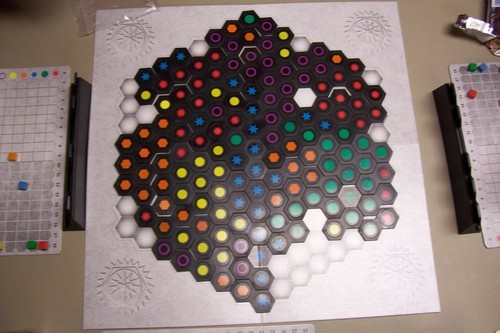
A great example of an entirely abstract Eurogame that is a lot of fun despite
a complete lack of theme, Ingenious. This one by German master game designer Dr. Reiner Knizia.

It is also worth mentioning, that even though games of this sort may not have a theme at all, where a theme is present, game objectives are almost universally nonviolent in eurogames. Trade, cooperation and building or connecting things are popular general themes, and elimination of other players pieces or resources are uncommon, and representation of warfare or other violence are nearly unheard of in thematic elements. This also means that many Eurogames may be played with little direct conflict between players, which many players like, but critics of the style of gaming lead to comparisons of eurogames as “competitive solitaire. Popular Eurogame titles include Puerto Rico, Power Grid and Settlers of Catan. In the United States, Rio Grande Games and Mayfair games are two of the largest publishers of this style.

Strengths and Weaknesses of Ameritrash games, according to my tastes:

Fans of this style of gaming have taken the “Ameritrash” label and turned it around as a term of distinction and affection for the style of game that they prefer. For those offended by the negative connotation of the term itself, or by its inaccuracy, as many games in this style are designed and published in countries other than the US, the alternate term “Thematic Game” is used instead. Theme is king for these styles of games, and virtually every play session results in a memorable and dramatic story. Many of these games focus on production values to reinforce the theme, and games with dozens or even hundreds of plastic pieces are not uncommon in the style. Success or failure at critical points in gameplay may depend on the draw of a single card or roll of a particular die, which is highly dramatic but some players may find the importance of randomness devalues strategic play. Sometimes, a player quickly finds themselves out of the running for victory due to chance, and “kingmaker” situations can occur where a player incapable of winning can instead determine who does claim eventual victory.

Runewars, with hand-painted components. Heroes fighting monsters instead
of engaging in commerce or trade... yep, Ameritrash.

It is important to note that pure wargames do not fall into this category, nor are mass market games like Monopoly or Clue meant to be included in the category. The focus on story, drama and theme means that most cooperative and questing games will fall into this category. Elimination of monsters, pieces controlled by opponents or even board elements are common in these games, and people who prefer entertainment with no simulated violence may find them distasteful. Popular titles that wear the Ameritrash or Thematic label include Twilight Imperium, Battlestar Galactica, Runewars, War of the Ring and Arkham Horror. Fantasy Flight Games is one of the largest publishers of this style of gaming, though Avalon Hill (both classic and post-WotC/Hasbro buyout) and Eagle Games are also well known publishers.

I've written articles about games in both styles, and until I was aware of the conflict in styles, I might have identified myself as a Eurogamer, but I find that more of my very favorite games fall under the Ameritrash style. I respect clever design and elegance of mechanics, and do believe that strategy should trump dice rolls in general (I hate Risk based on that principle alone.) However, on the other hand, I am a sucker for a good story, and I can't imagine recounting the tale of having efficiently spent my action points to friends. I will, however, re-tell the time in Battlestar Galactica when I was successfully outed as a Cylon in the early stages of the game, but was so convincing in my demonstrations of loyalty that I had the player who saw my loyalty card wondering aloud if he'd been incorrect, making my eventual betrayal of the fleet more exciting and the Cylon defeat more dramatic. I will, then, do the only logical thing. I won't take sides. I'll just keep playing both.
Best Blogger Tips
  • Stumble This Post
  • Save Tis Post To Delicious
  • Share On Reddit
  • Fave On Technorati
  • Buzz This Post
  • Tweet This Post
  • Digg This Post
  • Share On Facebook
Blog Gadgets