Showing posts with label board games. Show all posts

Monday, October 10, 2011

Warrior Knights – Politics, War, Faith and Trade

This past weekend I managed to celebrate my imminent return to the workforce with an activity I haven't been able to participate in for a while now. My wife and I had a few friends by to play board games, and I got to play favorites of mine that have collected dust for years. Among these was one of my very favorites, Fantasy Flight's version of Warrior Knights. Not so long ago, I wrote about the difference between Eurogames and "Ameritrash" or Thematic board games, and Warrior Knights straddles the line between these extremes neatly. As a result, its design heavily influenced several popular games currently in production including RuneWars and Chaos In The Old World. It is a complicated looking game that is actually pretty simple, though it is not without its flaws, as I'll get into later. This is a revamp of the original published by Games Workshop, with European Game designers brought in to make the mechanics more appealing to modern audiences.

Parallels have also been drawn between this and A Game of Thrones (the Board Game.)

The layout, board, counters and pieces are classic Fantasy Flight. They are well made with solid artwork and plenty of components, but none seem unnecessary. The game is intimidating, as there is a lot going on, and the first turn will take so long unless everyone is a veteran that you'll lose sight of the fact that using standard rules, it'll be over inside of 5 turns. In a generic medieval country that has knights and lords with French, British, Italian and German sounding names, the king died without an heir. Without a clear line of succession, the Barons maneuver for the power to delare themselves monarch. This means that influence must be accumulated, and the easiest way to do that is to bring cities under your control, and keep those cities. Every player must plan six moves from strategy cards in their hand with a little control over what happens first, and then see how fate and the plans of other Barons make their plans all fall apart.

Each turn, players choose six general strategies which allow them to move and/or attack, serve the church, gather political support, levy taxes, draft mercenaries or allow for a less powerful but more versatile strategy. The players put the two orders they'd like to see happen first in a stack marked "1", second in the "2" stack and then third in the "3" stack. Two neutral strategy cards are added to each pile, the three stacks are shuffled and then orders are executed one at a time in a random order. When orders are executed, the strategy cards are temporarily discarded to one of three piles which will trigger sub-phases when those discard piles fill up completely. The piles are labeled Taxation, Wages and Assembly, and when each triggers, income from captured cities is given out, soldiers must be paid or released from service, or Barons convene to vote on legal matters, respectively. Until those piles clear and trigger their phases, those cards are unavailable to use again by the player who spent them.

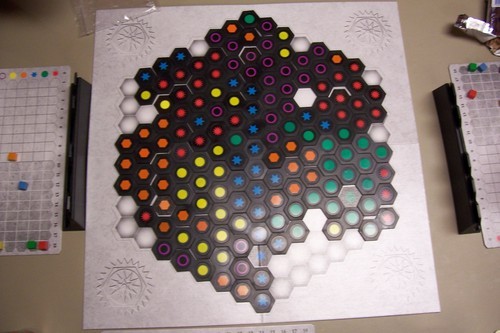
Game in progress at CABS in Columbus, OH.

To build an empire, players must supplement their own loyal troops with a mercenary army, levy taxes to pay for army upkeep and build a stable economy. Hiring mercenaries and outfitting all troops is difficult to do with taxation alone, so there are several other options to get money rolling. Players may choose to invest in trade expeditions to the far east, gather support to have trade concessions legally assigned to them, or conquer cities in foreign lands. Balancing income versus military might is essential, as the most lucrative options for making money don't typically directly contribute to victory, and large armies are expensive. Getting new soldiers is handled through a mercenary "draft" where anyone who chose to use the "draft soldiers strategy" is allowed to pick, in order from the new units ready to be assigned to nobles.

Taking cities and fighting with these armies is fairly simple. Each player has four commanders to move around the board, each has a special power. Cities can be assaulted at the risk of damaging the defenses and/or taking casualties for a quick (1-turn) capture, or with a large enough army a city can be besieged for 2 turns and it will automatically fall without any damage to defenses or the attacking army. Sieges may be lifted by any player attacking the besieging forces, and in a game where victory points are calculated at the end of every turn, risking two turns to maybe get nothing is significant. Armies and cities get to play one Fate card per 100 troops, with armies led by a noble (anything except an uncontrolled city) getting two extra draws to choose from to represent tactical ability. Fate cards may inflict 100 casualties, prevent 100 casualties or generate 1 victory point. Resolving fights is simple, if either side took enough casualties to wipe out all the troops assigned to them, they lose (and casualties to cities also represent broken walls, etc.) If neither side is wiped out by casualties, whichever side has the most victory points wins, and the opposing force is killed (but buildings take no permanent damage from this phase.)

Each noble may command an army and move about the board, while the Baron
(representing the player) only fights if the home Stronghold city is attacked.

Nobles limit how many places you can be at once, as there are only four of them and all your troops must be assigned to any nobles on the board or to defending your home base. When a noble dies, they are off the board for a turn and a card is pulled to see if any mercenaries under their command desert (by nationality.) The next turn, the noble's heir commands his dead father's forces and rides out again. If nobles don't stay at a captured city, that city may revolt, so rapid expansion comes with risk as well. The power of each of the four nobles either allows them to prevent 100 casualties, deal 100 extra casualties, generate +1 victory in battle or to not have to pay wages to any army smaller than 450 troops. Figuring out how many troops to assign to each and where to place the nobles helps determine who wins.

There are also two roles that players fight for throughout the game, the Chairman of the Assembly and the Head of the Church. Assembly Chairman gets to choose where trade expeditions are started and breaks ties in votes on agendas. Agendas may grant extra income, grant titles (with free troops) to nobles, or put rules into effect for the rest of the game. The Head of the Church may decide to bless trade expeditions to increase their chance of success, and also spends faith to influence the events deck. The events deck may grant free influence, have nobles assassinated in the field, affect plague or revolt, or even declare that a noble has no heir and may not return with his troops to the board when killed.

The game has an expansion that addresses some of the flaws I talk about below.

The biggest problems with the game are that a runaway leader in early turns is hard to catch, as everyone gets influence from all cities every turn, so a player in the lead must be attacked quickly, or everyone else falls behind. Experienced players can deal with this by keeping the game close through a lot of aggression, if people play passively, the outcome is determined almost from the very beginning. Also, the amount of influence in the pool determines game length, and the default number of 10 per player means the game tends to end abruptly just as it is getting good. Adding more influence per player fixes this, but it also makes the game take quite a bit longer. I think that the default shorter game is good to teach it, but after learning the rules, 15-20 influence per player makes the overall play more satisfying. I'm looking forward to giving it another go, as I don't play often enough to not have to play the shorter default version to re-learn it every time.
Best Blogger Tips
  • Stumble This Post
  • Save Tis Post To Delicious
  • Share On Reddit
  • Fave On Technorati
  • Buzz This Post
  • Tweet This Post
  • Digg This Post
  • Share On Facebook
Blog Gadgets

Monday, August 29, 2011

Boardgame Battle Lines: Eurogames and “Ameritrash” games.


While doing legwork, and double-checking details for some of the articles I've posted here about board games, I've frequently found myself over at Boardgamegeek. Any individual game that has a page on that site (and most of them do) will be tagged with descriptive links not unlike the tags you see on a blog post. Among these tags, you might find “4 player,” “wargame,” “cooperative” or other elements referring to particular mechanics or themes. Not so long ago, I noticed a tag I was unfamiliar with. The tag name was “Ameritrash.” I thought to myself “That sounds unfriendly,” and set out to determine what the term meant. I uncovered not only a new slang vocabulary word, but a schism in the hobby board gaming communtiy that I was previously unaware of, and one I'd be hard pressed to take a side in.

Eurogamers deep in thought at a Puerto Rico tournament.

Ameritrash games are, in general, games that have many components, use random elements to build drama, and strongly adhere to a theme. The term was coined in a derogatory sense by gamers who instead prefer a style of board game called the “Eurogame.” Eurogames tend to focus on balanced and logical mechanics with few or no random elements and if a theme is present at all, it tends to be represented in a highly abstract way. This seems to be a classic “Geek Wars” sort of question like Marvel or DC, on its surface, and I can see how the two styles are completely opposed on key points. That said, I'd find it difficult personally to take sides in this debate. I have in my collection games falling on both sides of the line, and I tend to enjoy both, so long as they are well designed.

Strengths and Weaknesses of Eurogames, according to my tastes:

Eurogames, in general, make a lot of sense. Assuming all players understand the mechanics, strategy should factor into a player's victory more than random chance. Dice are rarely used, and random elements tend to hinge more on whether a fortunate card, tile or counter is drawn at the particular time a player is capable of using it to gain an advantage. Action point mechanics are common in this sort of game, and frequently the individual elements of core gameplay could be distilled to their essential components and you'd have something that looks a lot like an equation. Game rules are in place to keep a single strategy from being too powerful or not powerful enough when compared to other strategies. Critics of this type of game sometimes find them overly dry, and in general they are not palatable to more casual board gamers, as frequently one or more plays are spent learning mechanics and grasping strategic subtleties. Someone who has never played a particular eurogame is usually at a disadvantage with an opponent who has played many times.

A great example of an entirely abstract Eurogame that is a lot of fun despite
a complete lack of theme, Ingenious. This one by German master game designer Dr. Reiner Knizia.

It is also worth mentioning, that even though games of this sort may not have a theme at all, where a theme is present, game objectives are almost universally nonviolent in eurogames. Trade, cooperation and building or connecting things are popular general themes, and elimination of other players pieces or resources are uncommon, and representation of warfare or other violence are nearly unheard of in thematic elements. This also means that many Eurogames may be played with little direct conflict between players, which many players like, but critics of the style of gaming lead to comparisons of eurogames as “competitive solitaire. Popular Eurogame titles include Puerto Rico, Power Grid and Settlers of Catan. In the United States, Rio Grande Games and Mayfair games are two of the largest publishers of this style.

Strengths and Weaknesses of Ameritrash games, according to my tastes:

Fans of this style of gaming have taken the “Ameritrash” label and turned it around as a term of distinction and affection for the style of game that they prefer. For those offended by the negative connotation of the term itself, or by its inaccuracy, as many games in this style are designed and published in countries other than the US, the alternate term “Thematic Game” is used instead. Theme is king for these styles of games, and virtually every play session results in a memorable and dramatic story. Many of these games focus on production values to reinforce the theme, and games with dozens or even hundreds of plastic pieces are not uncommon in the style. Success or failure at critical points in gameplay may depend on the draw of a single card or roll of a particular die, which is highly dramatic but some players may find the importance of randomness devalues strategic play. Sometimes, a player quickly finds themselves out of the running for victory due to chance, and “kingmaker” situations can occur where a player incapable of winning can instead determine who does claim eventual victory.

Runewars, with hand-painted components. Heroes fighting monsters instead
of engaging in commerce or trade... yep, Ameritrash.

It is important to note that pure wargames do not fall into this category, nor are mass market games like Monopoly or Clue meant to be included in the category. The focus on story, drama and theme means that most cooperative and questing games will fall into this category. Elimination of monsters, pieces controlled by opponents or even board elements are common in these games, and people who prefer entertainment with no simulated violence may find them distasteful. Popular titles that wear the Ameritrash or Thematic label include Twilight Imperium, Battlestar Galactica, Runewars, War of the Ring and Arkham Horror. Fantasy Flight Games is one of the largest publishers of this style of gaming, though Avalon Hill (both classic and post-WotC/Hasbro buyout) and Eagle Games are also well known publishers.

I've written articles about games in both styles, and until I was aware of the conflict in styles, I might have identified myself as a Eurogamer, but I find that more of my very favorite games fall under the Ameritrash style. I respect clever design and elegance of mechanics, and do believe that strategy should trump dice rolls in general (I hate Risk based on that principle alone.) However, on the other hand, I am a sucker for a good story, and I can't imagine recounting the tale of having efficiently spent my action points to friends. I will, however, re-tell the time in Battlestar Galactica when I was successfully outed as a Cylon in the early stages of the game, but was so convincing in my demonstrations of loyalty that I had the player who saw my loyalty card wondering aloud if he'd been incorrect, making my eventual betrayal of the fleet more exciting and the Cylon defeat more dramatic. I will, then, do the only logical thing. I won't take sides. I'll just keep playing both.
Best Blogger Tips
  • Stumble This Post
  • Save Tis Post To Delicious
  • Share On Reddit
  • Fave On Technorati
  • Buzz This Post
  • Tweet This Post
  • Digg This Post
  • Share On Facebook
Blog Gadgets

Thursday, August 4, 2011

Twilight Imperium, Third Edition. Not a cheap game or a short one, but worth the time and money.

The line of thinking that led me to yesterday's article on Babylon 5 persists, as I continue to have a head full of space stations and politics, intergalactic war and diplomacy. This brings to mind a question similar to the one that put me back into a B5 mood: What is your favorite game? For me, this question is overbroad. It would be much easier to answer favorite food, favorite music or any other of a number of questions that a reasonable person might say “can we narrow it down a bit?” It is impossible for me to compare all the card games, roleplaying games, video games, board games... so let's concentrate on that last one. I can, without moving my head much, see over 150 board games from where I'm currently seated. Surely, amongst those, there must be a favorite. That's not a particularly difficult question, especially considering that I have galactic conquest on the brain anyway. My favorite board game is Twilight Imperium.

Flat out amazing, and not nearly as complicated as it appears at first glance. Everything is
exceptionally planned here, from rules reference to space for component storage.

Published by Fantasy Flight Games (in fact, the 1st edition was their first product,) Twilight Imperium is a board game of Galactic conquest, politics and trade. There is a genre in PC gaming that sums up what TI does so well called “4X,” pioneered by games like Master of Orion, the strategy titles call upon an empire-builder to do four things well. Explore, Expand, Exploit and Exterminate. In an unstable galaxy, each player controls a civilization bent on stabilizing the universe under their own control. There are many paths to victory, military conquest, the research of advanced technology, political maneuvering, effective trading... the most successful race will master more than one of these and be crowned victor. Though it has many, many pieces representing capital ships, marines and fighters, focusing on war to the exclusion of all else is a very risky strategy, as a potential tyrant may see a weaker foe claim a political victory before he can be completely wiped out.

Let's start with some of the basics. This isn't an inexpensive or short game. Twilight Imperium, Third Edition will take 4-8 hours for the recommended 4-6 players presuming everyone has at least a passing familiarity with the rules. Regular retail price is $89.95, but a look at the components tells you why. There are over 350 plastic figures for space and ground units and structures, well over 400 cards and many durable full-color counters and board tiles, as well as the reference cards and playsheets for each of the 10 playable races. The massive 12”x24” box has more than enough room for everything, and can accommodate a basic storage system to keep it all organized for faster setup for the next game. Victory conditions are determined at the start of each game, with some public goals that everyone works toward, and some secret goals distributed at the start of the game.

Layout for a full six-player game found over at BoardGameGeek.

With the different special abilities presented by each race, the somewhat random victory conditions that might include researching a particular technology, controlling a certain number of planets or building a number of a specific unit, and the board setup, the game will be different every time. The galaxy is created with tiles placed semi-randomly in a specific arrangement around Mecatol Rex, the political heart of the galaxy. This “Settlers of Catan” style board setup has players all involved in setting up the board so the strategy begins before the first turn. In addition to each race having a unique mechanical ability, they start with slightly different technologies and military units, making the play of each one distinct. Theme reigns supreme in everything, from these mechanics to the uniformly gorgeous art found throughout.

In a game like this, typically you'd have one player taking a long turn managing their empire, making units, collecting resources, executing actions and rolling dice for battles, while everyone else sits there bored and waiting to play. What makes this my favorite game is that this does not happen. Taking a cue from the Eurogame Puerto Rico, at the start of the active player's turn, they select a strategy from the remaining options left in a communal area. This strategy token allows the active player to perform a specific strategic or tactical action, such as building or moving units, seizing first choice of strategies for the next round, or simply gaining a victory point. The strategy token also allows every other player to optionally take a different specific action from the one the active player took, also printed on the token. Everyone is involved on each turn, and everyone stays interested.

These tokens push it over the top from "good game" to "amazing game".

From there, players explore and colonize planets, build bases and starships, research technology that may be deadly, like new weapons or ships, utilitarian like improved engines, or both. Players enter into trade agreements, make and break alliances and get involved with politics, casting votes on measures that introduce rules encouraging or imposing sanctions on military action or expansion, or a host of other mechanics including political titles. Players careful to build their alliances and not appear overly threatening can build quietly toward victory, or snatch victory from the jaws of defeat with a well-timed and surprising vote, trade agreement or completion of secret objective. Frequently games end with someone who is apparently in third place or worse declaring victory at the end of their turn, making it difficult to know when to make or break alliances and with whom.

Combat plays out like an advanced version of “Axis and allies” with long range orbital lasers and War Suns (think: that's not a moon, its a space station) providing heavy support for capital ships and waves of fighters. 10-sided dice are used in conjunction with tactics cards to set to-hit numbers to cause casualties on the enemy side, and there is even a card that allows for the possibility of a “trench run” for a single fighter to find and attack a War Sun's weak point. Ground combat is more of a “soften them up with an intial shot from space and send in the marines” affair, with strength of numbers and good dice rolling forming the bulk of the action. A player who either ignores their war machine or concentrates on it to the exclusion of all else does so at their peril. War as a primary path to victory is a difficult one, but it should be nearly every players second priority.

There's a lot of plastic in that box.

I've played this nearly a dozen times, and we still haven't even used the variants featured in the box itself that include “great leader” tokens and random events for each planet that you can land on before colonization. There are two expansions now, one brings the maximum player count up to eight and adds new races, mines, shock troops and artifacts; the other adds flagships, race-specific technologies and alternate strategy tokens as well as scenario-based play. Both expand the stock of components with more cards, tiles and tokens to keep gameplay fresh for anyone who is becoming overly familiar with the base game elements. Though it requires that I set aside a Saturday and quite a bit of space to set up and play, I can't remember a session where anyone was dissatisfied.
Best Blogger Tips
  • Stumble This Post
  • Save Tis Post To Delicious
  • Share On Reddit
  • Fave On Technorati
  • Buzz This Post
  • Tweet This Post
  • Digg This Post
  • Share On Facebook
Blog Gadgets

Monday, July 18, 2011

Agricola, by Z-Man Games – Farming as a boardgame is way more fun than it sounds.

This past weekend, I spent quite a bit of time in the company of friends at multiple gatherings. Usually, once things get going and people have had the chance to chat, catch up and get a bit to eat and drink, we're looking for some sort of activity. Invariably, since many of my friends are nearly as geeky as I am, board games come up. Two of the more popular choices these last few months have already been reviewed/discussed by me previously: Battlestar Galactica and Shadows Over Camelot. The only other game I've played more than once in the past few months is a relatively new one without knights, spaceships, or fighting of any sort whatsoever. We've been playing Agricola, a game about farming.

A game besides Settlers of Catan where the less mature gamer can
make jokes about wood and sheep. Yeah, I've gone there.

Personally, I actually like farming games period. Harvest Moon is a video game series I return to regularly, and the combination of resource management and simulation aspects of these sorts of games I think appeals to the deep-buried part of me that desperately wants to be an accountant despite the fact that I'm terrible at math. Agricola has one of the things I really adore about the best games. You have many options for what you can choose to do with your turn, and there are many different and equally viable strategies to win. There are a lot of things on a successful farm, and having each gets you points based on quantity and a farm missing one of these key things loses a few points. Victory points are awarded for efficient use of land, having stables and fences built, having grain, produce and livestock, and the size and quality of the farmhouse and number of people in the family. Bonus points are available for improvements made to the homestead such as a cooking hearth to bake bread, a well, or a pottery or basketweaving business to sell goods to augment the family income.

The components of the game are high quality, which is nice, as Z-Man Games is evolving as a company to be taken seriously in the boardgame world. Some of their early games had solid mechanics, but the components just weren't as well made as something from, say, Days of Wonder, Fantasy Flight or Rio Grande Games. I'm glad that the nice painted bits of wood to represent resources, building materials, animals, etc. as well as the cards, boards and counters are all very well put together. The game itself has a main board which displays the options players may choose on each round (which start simple, and evolve as the game develops,) and each player has their own board to store their harvested resources and to build the farm on their own plot of land. Cards are used to scale the game based on the number of players and how complex you wish the rules to be, different cards representing options players may select on their turns.

A nice overview of the bits and pieces.

Each player has a number of actions equal to the current number of family members they have (families start with 2,) to work in each phase. Work might mean a number of things, but in order, each player selects an option on the board, and only that player is allowed to perform that action for that phase. Each new phase starts with one new possible action that may be taken, and spaces on the board that produce resources refill if they were selected on previous turns, or additional resources are placed if they were not. This makes spaces neglected for multiple turns more attractive options as time goes on. Players can collect wood, clay, reeds and stone, get animals, build fences to give livestock a place to live, plow fields, sow grain or vegetables or improve their homes. Balanced against the “gather and build” mechanics is the need to feed your family. Every harvest, crops give farmers more veggies or grain, animals breed (if you have room for more and two or more to handle reproduction) and the family members have to eat.

Getting to do everything you want in a turn with the looming threat of needing to feed the family makes the game a balancing act of managing your actions on each round, and hoping that you aren't blocked off by another player who gets to act first. You can't eat raw grain or just grab a fork and eat a cow, so improvements to bake bread or slaughter and cook livestock are key. If you find yourself constantly out of position due to going late in the round, selecting the “take 1 free food and the 1st player token” is attractive. It is also very possible that you may spend several actions gathering wood only to find that someone else has blocked you out of the ability to build fences or stables, so the timing of your actions is nearly as important as managing your resources. The most successful players will be efficient on every turn, balancing the need to survive the next harvest against the desire to make sure that there is a little bit of everything in the farmstead for endgame, when victory points are counted up.

An example of an endgame farm with a little something in every bit of land.

I've played a few times now, and as a board gamer I usually turn my nose up at the least complex version of the rules when there are multiple options presented. The “family game rules” are the version I've been describing up to this point, and the play experience is suitably rich and I'd say rather more complex than a typical game of Monopoly or Risk. The advanced game adds in profession cards for family members and minor improvements that may be built around the farmstead for more bonus points and additional options on any given turn. I look forward to playing a few times with the advanced rules, but this is a complete and fun game even without them. The game takes about 2 hours assuming you aren't teaching the rules for the first time, and supports up to 5 players, with solo play as an available option. Ages of 12 and up are suggested for the game, and younger players will need to be fairly patient and bright, as this isn't a traditional “kids game.”
Best Blogger Tips
  • Stumble This Post
  • Save Tis Post To Delicious
  • Share On Reddit
  • Fave On Technorati
  • Buzz This Post
  • Tweet This Post
  • Digg This Post
  • Share On Facebook
Blog Gadgets

Wednesday, June 1, 2011

Cheapass Games. No, really. That's the company name... and they're back.

So, I play a lot of games. That's been made pretty obvious. I know that there are a few people out there who share my passion for gaming (whether that means tabletop rpgs, video games or card and board games or “all of the above”,) and also share my limited financial capacity. In the card and board gaming arena, there are quite a few options for solidly designed games for only a few dollars. I am, of course, talking about Cheapass Games.

I purchased a LOT of these when I managed a hobby shop.

Cheapass Games was founded on a couple of important concepts, the first being that the most expensive part of producing any board game is the box, board, dice and other components like pieces. This is how you very quickly get to $30-$50 games, and a lot of the pieces are really interchangeable. Do you really need another set of play money with the same denominations once you own Monopoly? How many different sets of little plastic bits to represent “you” are really necessary? The minds behind CAG likened including all this expensive and redundant stuff with every game to shipping every can of soup with a spoon and can opener. The truly important stuff, the unique cards, the board if there is one, and the rules themselves can be produced and sold for a whole lot less.

Cheap-Ass Games founder James Ernest.

The other philosophy driving the game design is making them “thought optional”. James Ernest, the mastermind behind the company described most games as “thought off” or “thought on.” Games where rolling the higher dice totals, drawing the best cards and consistently having chance favor you independent of decisions you make (if there are any) are “thought off.” Having a plan doesn't really affect your ability to win. A “thought on” game is like chess, where the person who makes the best decisions always wins. CAG titles allow gamers to increase their chances to win by playing better, but being the best at a game doesn't make the outcome a foregone conclusion.

Originally named "Before I Kill You, Mr. Bond" until a cease and desist letter made for a reprint.

With a low price point and indie-game studio ideals, CAG was able to make a whole lot of inexpensive games with a VERY wide variety in theme. There were clever takes on classics, like “Kill Dr. Lucky”, which is the game played before a murder mystery game like Clue, everyone is trying to murder the victim, but fortune consistently favors him and he escapes his fate for another turn. Games where the concept was almost a gag, like “Exploding Cow” solving the Mad Cow and dangerous minefield problems simultaneously, or “Give me the Brain” at Friedley's, a fast food restaurant staffed by zombies who need to complete tasks to end their shifts, but only have a single brain to pass around.

Classic edition, this was later released in full-color as a "Special Edition". 

Some of my personal favorites from the company were:

  • GET OUT, a Monopoly like game where every player is a loser living at home without a job or social life, the goal being to be the first to get a job, a life and an apartment.
  • (James Ernest writes off another trip to) VEGAS, a casino game with lots of mini-games around a board themed on the City of Sin.
  • Witch Hunt, where players take the role of attorneys profiting from either prosecuting or defending women (an occasionally men) accused of Witchcraft by presenting evidence of purity (Goes to Church) or questionable habits (like Owns Many Cats.)
  • Deadwood, a game with many expansions about being a bit actor in terrible low-budget movies.
Button Men, a Cheapass dice/fighting game is now available as actual buttons from CafePress that you can pin to things, on line play via the website, or as an iPhone app.

Many of the titles are currently out of print, as the Cheapass games website initially stopped updating in 2007, with many designers moving on to other careers and companies. However, in February of this year, updates and promises of new and exciting things from the company began appearing on the previously defunct site. One of the coolest things is the release for free of some out of print titles for “print and play” here on the website, with a request for a donation or purchase of something currently available if you like the free game. James Ernest himself returned to the helm of the company on April 30, 2011 from his time working in the Computer Gaming industry, and we'll hopefully see new inexpensive titles and maybe even the occasional reprint in the months and years to come.

Best Blogger Tips
  • Stumble This Post
  • Save Tis Post To Delicious
  • Share On Reddit
  • Fave On Technorati
  • Buzz This Post
  • Tweet This Post
  • Digg This Post
  • Share On Facebook
Blog Gadgets

Thursday, May 19, 2011

So... What *is* Next, Anyway? - This Blog, and Other Projects To Help Me Not Starve.

I've been thinking a lot about the question posed by the title of this blog... What's Next? For anyone who hasn't been with me from the beginning, I started this project not really expecting anyone besides me would ever read it. I wanted to sharpen my writing through daily practice and cope with losing a job that had meant a lot to me. The URL “Getting My Head On Straight”, referred to my original first post, the text-heavy biographical introduction in those days before I learned how to include images and links. Don't worry, this article won't be me whining about my situation in a desperate play for sympathy. I'm happy with where I am, but I posed a question to myself about where I'm going... and that one isn't quite answered yet, so bear with me as I talk about upcoming possible projects, the future of this blog, and I'll be back to writing about specific bits of geek culture tomorrow.

Traditional wisdom says not to blog about yourself very often, as you aren't the most interesting
person to the average person in your audience, they are.  I do this rarely, so here's a picture of the man behind the blog, and the wife behind that man... smushing my face into an unusual shape.

When traffic and readership started to grow quickly (I've only really been doing this since late February, though it feels like longer) a question I was asked quite a bit was “So how long can you keep this up?” and the corollary “That's neat, but what are you going to do with it?” I've got plenty of ideas left in me for articles, I don't see that becoming an issue anytime soon. If I got a traditional job tomorrow, I'd no longer be "The Unemployed Geek", so what would happen to this site? Someone suggested that my new career could be “blogger”, and I joked that if this became my job, I'd no longer be unemployed, so I'd put myself out of work... Then I'd be eligible to start again in a never-ending recursive cycle.

I plan to keep this blog going indefinitely, regardless of what my situation is. I might post less frequently if I had less free time, but I'd like to believe that I have the discipline to continue regardless at near my current pace. As for making a living writing for my own site five times a week... it is a pleasant dream, but one that I'll only believe in once I have evidence that it is possible. Once daily traffic gets to a certain point, I'm not above adding a PayPal donation box, but until I'm satisfied that I provide sufficient value to a large enough audience to justify it, I'm holding off on that. If I bring in a few dollars here and there from this someday, that'd be nice, but it really isn't about the money.


Malcontent Blogger
Credit to Blaugh.com on this comic, hits close to home(less.)

So... What is next, then? I have a few projects that I've been kicking around, and the last time I wrote something like this, (about being unemployed) I talked about non-traditional methods of income. I suspect that if I can finish one (or more) of these ongoing projects, I might be able to carve out something resembling an income before I've run out of unemployment benefits. Here's what is currently on my plate:

No fewer than three longer form writing projects, one a collaborative effort with my wife. In no particular order, they are:
  • A fantasy novel told from the perspective of an elite squad of investigators called in by royalty to handle crimes that the typical City Watch strategy of holding a torch aloft and yelling “Who goes there?” can't solve. (Think: modern investigative crime show a la CSI meets Lord of the Rings.)
  • A horror/fantasy novel set in a world with industrial/steampunk elements (though most of the technology runs on toxic fuels with nasty side effects) featuring an agent of the Council Government who specializes in dealing with religious cults who stumbles down a path that has already claimed the lives of thirteen individuals trying to stop an ancient horror before him.
  • A tongue-in-cheek semi-autobiographical work talking about how, when I was a single man, I learned to talk to and attract members of the opposite sex using ideas similar to those “pick up artists” use, only translated into gaming concepts and a lot less sleazy. (Think: Neil Strauss' The Game meets World of Warcraft.)
When any of these are finished, I'd like to release them as e-books for the Kindle store, taking advantage of generous royalty options. I figure talking about my ideas publicly gains me more in gauging which ones are legitimately interesting, over the typical new author's fears that letting the ideas out subjects them to possible theft. I'd be disappointed to learn someone stole one of my ideas and made a fortune off of it, but I have confidence in myself to continue to come up with and develop creative concepts.

I also have a three-quarters finished design for a board game where each player hires a team of mercenaries and equips them, and competes to be the first team to establish a base of operations and take down a Warlord in a Banana Republic. I'd need to start a Kickstart project for funding to complete this one, at least to get it to the prototype stage, with rewards for supporters including naming a Merc after someone who donates a certain amount. The concept is most like “Jagged Alliance meets Arkham Horror.”

One of my favorite games of all time, and I think hiring mercenaries in a "Questing"
style boardgame is one I'd like to play, so I'll have to make it.

Regardless of what I pursue to completion, I'll also be quietly working on a redesign for this site, as I have enough articles that people keep coming back for to justify a magazine-style layout someday, maybe making the jump to a custom domain name at the same time. Anyone find one of the things I'm working on to be of particular interest? Someone think I made a horrible mistake by putting unfinished concepts out there where someone could steal them? This is one I'll be eagerly watching the comments on. If there is enough interest in one or more of these projects, I could post status updates here, or in a second blog expressly for that purpose. Your input, please.
Best Blogger Tips
  • Stumble This Post
  • Save Tis Post To Delicious
  • Share On Reddit
  • Fave On Technorati
  • Buzz This Post
  • Tweet This Post
  • Digg This Post
  • Share On Facebook
Blog Gadgets

Monday, April 25, 2011

Board Gaming for Adults - Beyond Monopoly and Risk

For seven years of the near-decade that I managed a hobby shop and acted as the primary games buyer (more on that here if you missed it) a few friends and I would use the shop's back room to play board games. At least, that's how it started. By the end, weekly we had between five and eighteen adults turning up to play, and sometimes we'd start Thursday at 8PM and not break until Friday at dawn. I'm not talking about Risk, (which I despise) or Monopoly, (which I can take or leave) or really any of the Parker Brothers/Milton Bradley fare. There's a whole other category of board game, with greater depth and complexity than the pasteboard mass-market games found in the children's toy aisle. I've personally amassed a collection of several hundred of these.

The attitude that board games are for children is one, as far as I can tell that is more common in the US and Canada, whereas in Europe (particularly in Germany) the board game as an activity for adults is not a “fringe” notion. Even here in the US, the hobbyist market for board games beyond “playing with the kids on a rainy day” has been growing steadily in the last decade. There is a distinct difference in the style, design and presentation of games that are primarily marketed to the adult who is a board game enthusiast.

What most Americans picture when you say "Board Games".

In terms of mass market games, there are several types that are extremely common, and understanding what they are and how they work helps to understand how the hobbyist's gaming differs. There are traditional abstract strategy games which have pieces such as pawns, tokens or chits. All of the most ancient games fall into this category, including Senet (the most ancient game from pre-dynastic Egypt, with sets dating as far back as 3500 BC) and Backgammon (3000 BC). This category also includes games of “perfect information” such as Go, Chess and Checkers, where there is no random element whatsoever, the strategy developing from forcing an opponent to react to your moves.

A modern recreation of Senet, the earliest known board game.

Most other mass-market board games are successors to the older abstract strategy games, and either move pieces along a predetermined path of spaces on a board (the "race" game), a contest to answer questions or figure out a puzzle (the “party” game) or resolution of an armed conflict (the “war” game.) “Race” games usually focus on the “roll and move” mechanic to have players compete to be the first to either collect certain tokens (in-game money being the most common) or get their pieces to a certain spot on the board. Monopoly, Pachisi, and even Candy Land fit this category. “Party” games, also called parlour games, typically involve individuals or teams trying to guess or deduce hidden information. Charades, Trivial Pursuit, Cranium and Taboo all fit this category. “War” games have pieces representing soldiers or units of armed forces, and are typically won by capturing territory or destroying opponent pieces. Risk, Battleship and Axis and Allies are popular examples, though the difference between a mass-market war game and one designed for hobbyists is sometimes just a matter of complexity.

Hate, hate, HATE this game. Yes, there may be a chance that when attacking with overwhelming force that a lone defender can take no losses and kill an attacker. That chance should not be 1 in 6.

While there are many more types and styles of board game that are marketed toward children and young adults, hobby games tend to differ mechanically and in presentation in specific ways. The most popular game in this style is Settlers of Catan, a game I've called the “gateway drug” of board gaming, and many of the design choices that make hobby games different are present. The distinctive elements in the rules and structure of these games has separated hobbyist gaming further, by splintering off another style of game into its own category. The War game, with popular titles including Europa, Advanced Squad Leader, Diplomacy and a host of other titles from the now-defunct Avalon Hill focus on and detail military actions in a way designed to represent a simulation. They are more detailed and complex than their equivalents on toy store shelves, and repesent a hobby all their own, which crosses over into miniatures wargaming (a topic so large, it could fill several blogs – and it has.)

The Limited Anniversary 3-D Collector's "Treasure Chest" Edition of Settlers of Catan.  $469 USD retail... and yes, I have one.

The specific design elements that are common to the rest of the genre that includes the Catan series of games and its expansions is as follows:
  • The games tend to be non-violent. Games in this style often abstract any sort of fighting, if it is present at all. Building, trading and otherwise growing something a player controls is the focus, rather than trying to eliminate something controlled by an opponent.

  • Resource management is one of the keys to victory. Whether it is in-game currency, actions or “action points” per turn or numbers of pawns, tokens or cards, most of these games reward effective and efficient use of available resources to increase score, claim dominance on a board, or otherwise collect whatever is required to win.

  • The impact of random chance is minimized in determining who wins. Many of these games feature dice, cards or other random tokens, but few use the “roll and move” mechanic that is common in “race” games. Though few are games of perfect information, where there are no random elements and every action an opponent may take is publicly known, a player can usually increase their chance of victory through capitalizing on good fortune, making timing and planning at least as important as a fortunate draw of a card or roll of dice.

  • Players frequently simultaneously cooperate and compete. This concept, minus the “compete” is a subgenre I've written about before, but any trading game features this idea. Railroad gaming often forces players to use each other's lines to travel or ship goods, and games where players must collaborate, even briefly, to earn victory points are common. They key to managing these sorts of cooperative efforts in these games is usually helping someone, but not as much as they help you.

Some of my favorite titles in this style of board game (some of which will likely merit a writeup all their own) are Twilight Imperium, Junta, Bohnanza,Ticket to Ride, Puerto Rico, Domaine, Merchants of Amsterdam and Ingenious. More than a few in my collection were also designed by the same man, Dr. Reiner Knizia, a mathematics professor who I've been lucky enough to meet several times. There is an exception to virtually every broad generalization I've made so far in this article, and I'm sure a few elements I've overlooked. Any other board gamers out there? What did I overlook or gloss over in the text? Let me know.
Best Blogger Tips
  • Stumble This Post
  • Save Tis Post To Delicious
  • Share On Reddit
  • Fave On Technorati
  • Buzz This Post
  • Tweet This Post
  • Digg This Post
  • Share On Facebook
Blog Gadgets

Wednesday, March 23, 2011

Co-Operative Games (Unplugged)

 When geeks typically think of Co-op, we think video games, usually first person shooters with a cooperative campaign mode, or maybe classic arcade games where 2-4 players could team up to beat up hordes of bad guys and work together to progress. I guess a lot of other forms of gaming are cooperative as well, as tabletop RPGs are cooperative in nature (unless you play with one of THOSE groups, or are playing Paranoia.) I love all these games dearly, but I'm not talking about any of these.

Red Wizard Needs Food - Badly. I show my age by using this as an image instead of something like Left 4 Dead.

I'd like to discuss a fast-growing niche in the tabletop board gaming world. The cooperative game, and its twin sibling, the co-op game with a traitor. My first board game article touched on one of the more complicated and popular games in this sub-genre, Battlestar Galactica. There were a whole lot of games released before BSG unleashed suspicion and paranoia into deep space.

The earliest ancestor of this style of game (as treated by my narrow definition that eliminates games with one defined 'antagonist' like Scotland Yard or Fury of Dracula) that I could find evidence of is Arkham Horror. AH was first published in 1987, with a redesign and re-release in 2005, making the first proper game of this type still one of the most popular today. Investigators in the 1920s fight monsters, dig up clues, and close Gates To Worlds Man Was Not Meant To Know. Players work as a team, trying to prevent the return of one of the Great Old Ones from H.P. Lovecraft's Cthulhu Mythos. Personally, I love the new edition of Arkham, with or without expansions, there is so much going on and it fits the cosmic horror theme, running around with tommyguns and eldritch tomes, defeating cultists and going insane from shoggoths.

Remember, any wins are temporary. The Old Ones will eventually destroy all When The Stars Are Right.

Five years before Arkham was re-released, though, Fantasy Flight put out the game that introduced me to the cooperative board game genre. Lord of the Rings, by master designer Reiner Knizia had a group of hobbits playing against the board itself, attempting to bypass challenges and complete the classic Heroic Journey before the Eye of Sauron can claim victory. I loved this when I first played it, but the years have not been kind, as other games reveal a key flaw. Every turn, the game says “I'm going to make you lose," and the entire play is spent reacting, merely trying to stop it. This means most key decisions are made randomly, and all the players can do is react.

On the upside, any homoerotic hobbit bed-bouncing is entirely optional.

A few years later, we have the first really popular game with the “secret traitor” mechanic, Shadows Over Camelot, published by Days of Wonder the same year Arkham Horror was re-released. This is the one that really got me going on the co-op board game, and I still play it six years later (as recently as Sunday, matter of fact.) Players are Knights of Camelot, and every turn, on one of the many areas and sub-boards representing threats to Arthur's Kingdom, something goes wrong or gets worse. The balancing act of resource management in dealing with these issues and completing these heroic quests is that one of the Knights may be a traitor working for Camelot's downfall. It is random every game, with 8 loyalty cards (and 3-7 players) it is also possible there is no traitor at all.

This game is typical of Days of Wonder... impeccably made, art and components both sturdy and very pretty.

More recently, we've seen a mini-flood of these games, highlights being Pandemic, Forbidden Island and the new Co-op questing D&D boardgames like Castle Ravenloft, based on classic adventures. There's just something different about the mood and atmosphere in a game where (at least most of) the table shares victory or defeat. I actually like a game in this style that beats us as a group of players occasionally, the challenge makes the victory over the common foe that much sweeter. Even if the foe is a deck of cards and a little collection of plastic and cardboard.
Best Blogger Tips
  • Stumble This Post
  • Save Tis Post To Delicious
  • Share On Reddit
  • Fave On Technorati
  • Buzz This Post
  • Tweet This Post
  • Digg This Post
  • Share On Facebook
Blog Gadgets

Tuesday, March 15, 2011

So Say We All... Battlestar Galactica... The Series and the board game.

 A few weeks back, a group of friends dropped by and we played a full round of the Battlestar Galactica boardgame. Based on the modern incarnation of the series, it models the best aspects of the show very well. The game starts as a cooperative game, trying to get humanity to safety while preserving fuel, food stores, morale of the fleet and the population of the last of the human race.

Obligatory joke about "she can preserve *my* morale" goes here.

The game inspired me to do what I'd never made the time to do in the past, fire up Netflix streaming, and finally watch the rest of the series. Now that I have quite a bit of free time, my wife and I have made it to mid-season 4 and I'm remembering everything that drew me to the show in the first place. Suspicion, betrayal, sacrifice... alliances made and broken as loyalties are questioned, surprises are revealed, and everyone pursues their own goals.

Believe it or not, all of these elements are represented in the game, with the players not knowing who is human and who is cylon... and knowing the show doesn't help you a bit in that regard. The game starts off with characters picked out and loyalty secretly assigned, each character has their own skills and abilities to help Galactica deal with its crises... Combat, politics, sabotage... these all come up as the fleet tries to make it to Earth.

Awesome Game... not cheap, and not short, though... set aside 3-5 hours for this one.


One of the key twists comes mid-game, when loyalties are re-assessed in a “sleeper” phase, and players who believed themselves human may “wake up” to discover they've been cylons all along, and the game continues with everyone pretending to work together as several players secretly work against the team, and people start using their powers, cards and abilities on each other out of suspicion.

Our game played out like this, with players working against each other, then with each other based on rapidly changing conditions as humans accidentally hinder each other and cylon players cleverly manipulate. The humans eventually won in our 6 player game, despite half the table being cylons or their allies by its end. A great deal of fun, and something I look forward to playing again.

Definitely a remake that eclipses the original in every way... at least so far.


As I close in on the end of the series, I reach one of those topics that geeks are bitterly divided on. The series final episode... I know so many people who hated the ending, and look forward to seeing it so I can judge for myself. Love it or hate it, I think this year I may have to pick up the expansion for the game and invite friends over for a few more rounds.
Best Blogger Tips
  • Stumble This Post
  • Save Tis Post To Delicious
  • Share On Reddit
  • Fave On Technorati
  • Buzz This Post
  • Tweet This Post
  • Digg This Post
  • Share On Facebook
Blog Gadgets