Friday, August 26, 2011

Two Decades Ago, There Was a Little Town Called Twin Peaks


As a lifelong geek, the unusual, the supernatural, even the disturbing are elements that act as enticements for me in the entertainment I choose to consume. Of course, everyone has their own limits there. I've watched most of director David Lynch's films and projects, and I don't always enjoy them. I kind of hated Eraserhead, liked Mulholland Drive even though it gave me a headache, and have really mixed feelings about Wild at Heart and Blue Velvet. It isn't surprising then, that my favorite Lynch project is the one with the most mainstream appeal, where his weirdness and dark, disturbing imagination is tempered by collaboration with Mark Frost, in the early 1990's mystery/drama Twin Peaks. Frost's stuff, on its own, usually has a strong sense of moving plot along and mainstream appeal, but doesn't have a whole lot of depth (he wrote a few entertaining but unremarkable novels and was a lead writer for the Fantastic Four movie.) Lynch is all depth, his work dripping with visual metaphor and convoluted and cryptic plotting, but he goes so far into his own worlds that the stories are nigh-incomprehensible to the average person. Together, they made something amazing.

Gone too soon.

Twin Peaks rose to popularity by posing a single question: “Who killed Laura Palmer?” The prom queen, volunteer, friend to so many in the little Northwestern town had her life ahead of her, and she was savagely murdered. The ritualized manner of her death brought in the FBI, most particularly the peculiar and unconventional Special Agent Dale Cooper. The atmosphere of the logging town with local eccentrics, long standing traditions... I'd be hard pressed to identify another fictional location that was as well developed. The town itself was a character with more depth than most protagonists in TV before or since. To this day, if someone talks about excellent coffee and pie, I think of Twin Peaks. The combination of mystery, soap opera, cop show and supernatural elements blended together to create something unique and special.

The town itself, and the plot, had three distinct layers. The top layer was the public face of the town, where the local high school kids ride motorcycles around with their girlfriends, the Great Northern Lodge ran its business, the quirky local sheriff's office handled local crime. The small town character on this surface layer was interesting enough, but just below the surface, there was something else. The seedy, secret side of the town dealt with addictions, sex, violence and madness that lurked somewhere below the local festivals and town meetings. Laura Palmer was the darling of the surface world, but just a little digging showed that she lived in the shadowy world of the town's secret shame. Almost every character has a secret that makes them touch on this second layer, and they'll lie, cheat and maybe even kill to keep these secrets.

To date, this man's best role.

The third layer of depth in the series and the town that gave the show its name is perhaps what it is best known for. A touch of the supernatural, where there are secrets that the town eccentric, the log lady knows and discusses with her pet piece of firewood. Something in the woods, connected to an ancient cave that locals know about, but don't speak of in the daylight, something that can send a message through military satellites in the SETI program. A figure with long hair, bestial in nature that insists that HE killed young Laura Palmer. Giants and dwarves who talk backwards, and an unusual room with red curtains for walls, a black and white zig-zag pattern on the floor and sparse furnishings where secrets might be learned in dreams, but not understood. A place real enough to have a name, The Black Lodge.

I loved this show. I was distraught when it was canceled, and more distraught at the ending, since the second season cliffhanger remains to this day unresolved. The demise of this series was, from the beginning, a classic case of studio interference in a great thing. Pressure was put on the series creators to pay off the mystery plot, to answer the big question of who Laura Palmer's murderer was by the end of the first season. David Lynch originally never intended that question to have a solid answer, the pursuit of the mystery and the dark twists and turns Agent Cooper and Sheriff Truman would follow were the story, they pursued an answer that wasn't important to the narrative. It was simply the driving goal that would motivate the characters to plumb the depths of the town's dirty laundry and start reaching that third layer of dark and ancient magic. This is probably why most people were unsatisfied with the answer once they got it, and stopped watching in droves.

This program was about a question. When it was answered, people said,
"All right, then." and they stopped watching.

Predictably, the studio responded with typical further interference. Long breaks between scheduled episodes, night and timeslot change, the full laundry list of what a network can and too often does go through to dismantle a struggling series' remaining fanbase. These actions inevitably result in cancellation, and that is precisely what happened. Incensed by the network's actions, Lynch refused to rewrite the series finale to provide closure, leaving it as originally conceived. Fans drew some hope when several years later, there was the Twin Peaks film, Fire Walk With Me... but many were disappointed to find that this was a prequel of sorts that answered no lingering questions and instead posed several new ones.

I highly recommend checking out the whole series if someone can stand the emotional impact of knowing there isn't a proper ending. The supplementary reading materials, from the Access Guide to Twin Peaks, to the Secret Diary of Laura Palmer and Dale Cooper's My Life, My Tapes really round out the setting and background of some of the principal characters. Answers are found in these books, if not resolution to hanging plot elements. Every few years, I go back and watch the two seasons of this 20-year old program again, and I think it has actually gotten better as I've gotten older, rather than tarnishing over time. I think I'd rather have the incomplete but compelling story of something like Twin Peaks over the host of other shows that got their plots wrapped up neatly by the end, but were never all that great to begin with.
Best Blogger Tips
  • Stumble This Post
  • Save Tis Post To Delicious
  • Share On Reddit
  • Fave On Technorati
  • Buzz This Post
  • Tweet This Post
  • Digg This Post
  • Share On Facebook
Blog Gadgets

Thursday, August 25, 2011

Dungeon Crawl: Stone Soup. Not just another roguelike, and a new project!


 Not so long ago, I wrote a little article about the roguelike RPG genre. In the course of doing a little light research to write that post, there was a roguelike that I hadn't mentioned but kept encountering the name of over and over again. No worries, I could do a second article someday, call it “roguelike roundup” or somesuch and profile a few more. So, with all the mentions of this particular game on Reddit and around the web, I figured it had to be pretty good, might as well try it out. Dungeon Crawl: Stone Soup is on its surface a roguelike RPG just like the others. Swords and Sorcery, ASCII graphics that can be replaced with a simple graphical tileset, random dungeon generation, etc. Lurking just beneath the surface of Dungeon Crawl is a game of astonishing complexity that is defined by a set of differences that don't seem to be such a big deal... until you try playing with them. I set aside all other roguelikes, and indeed, most other video games, and wow did I ever get into DCSS, setting aside games I paid for in favor of this free masterpiece.

A.. splash screen? For a roguelike? Yes, this is something different.

The first thing someone loading Dungeon Crawl (current version at time of this article is 0.9) will notice is the unusually high number of different races and classes to choose from when creating a character. There are 24 different species to choose from, and each has its own strengths and weaknesses, aptitudes for learning various skills and rate of level advancement. From fantasy staples such as human, elf, dwarf and orc to the more exotic merfolk and kenku, traditionally evil mummy, vampire and demonspawn, each species plays distinctly different. There are 27 different classes, or backgrounds, though it is worth pointing out that 9 of them are different flavors of wizard. Through updates, species and backgrounds are constantly being evaluated to make sure they are different enough in terms of how they play to justify their inclusion, and those that don't make the cut are excised from future version updates. The group that is in the game now are a solid stable of potential combinations for play.

This game is hard. Not hard in a “I can't figure out the controls or options” sort of way like Dwarf Fortress, and not arbitrarily difficult in an unfair way. After the initial few dungeon levels, most character deaths are the fault of a mistake in the player's tactics or strategy. Dungeon Crawl balances choosing equipment and trained skills, managing resources and effectively analyzing which threats are too difficult and escaping them for success. Unlike in other roguelikes, characters don't have to kill everything they encounter on a level. Sometimes, teleporting to a nearby stairwell and skipping a dungeon level is the best way to go. In the quest for the Orb of Zot, there are 27 main levels of the dungeon, and many side-branches and sub-dungeons arranged by theme, picking which of these to explore and how deep to go into them is key to success. By the end, a player will need three runes minimum from the deepest level of the branches to get into the realm of Zot and get the Orb.

Many different skills to train, choosing the right ones is key.

Another key difference between this game and other roguelikes is the existence of online play. Not online multiplayer, mind you, it is strictly a single player game. Playing online allows tracking of your various characters lives and deaths, a scoreboard and other players can observe and comment live, giving advice as you play. In addition to these features, rarely on certain levels of the dungeon, you may encounter the ghost of another player's character who met their end on a particular floor. In a way, even your failed characters live on as foes, providing a passive sort of PvP. “Busting” these player ghosts is an experience that always provides a thrill, because many of the spectres are much harder than a typical enemy. Takedowns of these monsters as well as Unique named monsters mark moments in a character's career that suggest a great story. There may be no default “plot” here, but some of the procedurally-generated drama is still compelling.

Dungeon Crawl has vast databases of knowledge about the creatures, spells and weapons, as well as the many gods available for characters to worship. There are 18 gods in the pantheon, some of which restrict worship to particular races or backgrounds. Each deity has criteria for worship, such as sacrificing corpses of foes or valuable magic items, learning spells or just killing things. There are sins against the gods that will turn them against you, the foremost of which is renouncing your devotion to their service. Gods make their displeasure known to those who cross them, in some brutal and spectacular ways. Advantages to service may include unique equipment, special powers, summonable allies, or in the case of Xom, god of chaos... you might just get messed with. Choosing a god (unless you play the demigod species) is as significant a choice as background and species, though aside from backgrounds that start with religion, the choice is delayed until you find an altar to the deity you wish to pledge yourself to.

A screenshot of my Orc Priest, with a recruited army of loyal followers on a jihad through the Orc Mines.

This game has inspired a small side project, represented by a second blog, Tales of the Cursed - Crawl For the Orb of Zot, that I've put up here. In addition to allowing me to do some writing outside the typical scope and theme of the posts I do here, the other site let me play with the layout and add things I wanted to here, but couldn't without a dramatic redesign. One of these features is a blog roll with popular posts from sites that follow me here and comment, links back to people who have supported what I'm working on here. Bounce over, check it out and add it to your subscriptions if it is something you might read now and again. I won't update that one as often as I publish here for sake of my free time and sanity, and may occasionally say something on this site when something new goes up over there.
Best Blogger Tips
  • Stumble This Post
  • Save Tis Post To Delicious
  • Share On Reddit
  • Fave On Technorati
  • Buzz This Post
  • Tweet This Post
  • Digg This Post
  • Share On Facebook
Blog Gadgets

Wednesday, August 24, 2011

Deus Ex, GameStop and OnLive - Technology Wars Bleed Into Real Life.

I'd planned an entirely different article for today, but when there's a story that needs attention the way this one does, I'll bump my intended post and risk another violation of my loose guideline to try to not write about video games more than once a week. This isn't really about video games. Or at least, not just about them. There's a heavy dose of irony in the story and surrounding controversy that broke hours ago. Deus Ex: Human Revolution is a new entry in a classic series of cyberpunk-themed hybrid RPG/Shooters, and is on target to be one of the best reviewed games this year. I'm not going to review it. Not because I won't play it, but because by the time I can justify the purchase and play enough of the title to give the game its due, my voice will have been drowned out by the chorus. There's another story here. Deus Ex focuses on a world where technology and pure humanity are in a war of ideals over ethics. In the real world, a GameStop memo was leaked indicating that all copies of the PC version of the game were to be opened before sale and a coupon for free online play on the new OnLive digital distribution/cloud gaming service removed before sale.

A war is on. A war over how you will purchase and play video games.

GameStop made this call because OnLive is in direct competition with their core business, and in addition to being able to play online, this marketing scheme gets consumers to install the service on their computers, and GS doesn't like that. The first shot in the war of physical retail vs online digital sales has been fired, and the irony comes in that Deus Ex was the title where GameStop drew its battle line. Opening a sealed product, removing a part of it that contains information that the corporation doesn't want people to see, and then selling it as new is unethical at best, maybe even illegal. Considering the content of the game in question and the ethics at the center of its plot, it is also sort of darkly hilarious. I don't know if the next round of this fight will be fought in court or if it will be left to a PR battle with reporting of the story and public reaction to it the ultimate arbiter of who was right, and what will be done about it.

This issue has been coming to a head for a long time now. More than one developer has said publicly that the resale of used games in a retail setting, though not illegal, is more damaging to the gaming industry than piracy. How does that work? Well, initial purchases of new titles involve everyone getting a cut of the sale from retailer, to middlemen to the publishers and development studio. A used game sale involves two parties, the consumer and the retailer. No one else sees any of that money, and this is the core of the GameStop business model. One-use codes unlocking online play, bonus features or at-launch DLC are commonplace now to fight against this practice. You want to buy a used game? Fine. There are features only included to first time-buyers that you can get... for a price. Selling the DLC that was free with a new copy of the game allows publishers and devs to get some of their cut, and brick and mortar retailers who deal in used games hate it.

...unless you mean the power to decide whether or not to use a free coupon
for a service packaged with the new game you bought.

I've got a little invested in all sides of this struggle. I'm a proponent of digital distribution (some will read this as “Steam Fanboy”,) and I trade in and purchase major studio console releases, having a GameStop Rewards membership. I understand and sympathize with all sides of this fight and how the competing business models interact is a subject that fascinates me. That said, I strongly object to GameStop's practices in this instance, as it smacks of dishonesty to loyal customers and seems underhanded as far as competitive practices go. The reasoning behind the decision also likely stems from the fact that in order to survive, GameStop has plans to enter the digital distribution market themselves. The question of whether or not a company should have to sell a product that represents competition for itself is a good one, and worth asking. Whether or not a company has the right to remove an included part of a retail package and still sell it as “new” isn't bad either, as I strongly doubt Deus Ex customers were told in advance of their purchase what they are missing.

This is also interesting because OnLive isn't just a Steam clone. If all it did was the same thing Steam, Desura, GoG and EA's Origin do, it doesn't change the context of the argument, but it might mean something a little different to gamers. OnLive is, at its heart, a service that is to console and PC games what Netflix streaming is to movies and television programs. Through PC or Mac, or a set-top box connected to a television and broadband internet connection, OnLive is a digital rental service where the software is located on the cloud of servers. Users can pay a monthly fee to access games in the cloud without needing to install them on local storage at all. For new releases (and other games not in the “play pack,” the option to rent a single title for three or five days or purchase access to unlimited play of that one game are available as well. The technical aspects of how exactly that all works is beyond the scope of this article, but it isn't hard to see how such a business model puts OnLive in opposition to GameStop.

Onlive's TV set-top setup. The service is still pretty new, and a lot of games aren't on it yet.
How it comes away from this fight may directly affect that though.

In the war in the world of Deus Ex, shadowy corporations put pressure on people to enhance themselves with cybernetics and take the drugs to make sure the implants remain stable in the body. Information is controlled, governments influenced and people killed on a massive scale to keep the profits of the corporations secure. People fight back, taking to the streets, violently at times against the manipulation of their bodies and minds by big corporations. The fight surrounding the release of the game isn't nearly as dramatic, the consequences and stakes aren't severe on anywhere near the same level, and there isn't a clear “little guy” here. We've got companies both offering things video gamers want in different ways, and their strategies are incompatible. Pressure on governments and control of the flow of information, however... well, some tactics are applicable regardless of the stakes.
Best Blogger Tips
  • Stumble This Post
  • Save Tis Post To Delicious
  • Share On Reddit
  • Fave On Technorati
  • Buzz This Post
  • Tweet This Post
  • Digg This Post
  • Share On Facebook
Blog Gadgets

Tuesday, August 23, 2011

Review – The Wolfman (2010 Remake)

When I first saw trailers for the remake of the classic Lon Chaney Jr./Bela Lugosi monster movie, The Wolfman, I was excited. They changed the setting to Victorian Era England, which as a fan of Rippers I would hardly complain about, the casting had a long list of actors I like, Benecio del Toro, Emily Blunt, Hugo Weaving, Anthony Hopkins... even a cameo by Max von Sydow (though this got edited out and only appeared in the Director's Cut of the final film.) The more I read about it, the more excited I got. CGI would be used for transformation scenes, but whenever possible, traditional makeup and effects tricks would be used, and visually the original monster would be the inspiration for the new creature's appearance. They even went out of their way to specifically name and place even the bit parts from the original film, a detail only the most obsessive of us film geeks would even notice. This movie couldn't possibly be bad! Only... it was.


Not just bad, atrocious. How so much of the planning and concept of a film can be so right, and the execution be so horribly wrong baffles me. With all of the pieces they had in place, screwing this up so completely takes real talent. I can't fault the actors for what they did with the material they had to work with, aside from a few uneven moments in establishing a character with a consistent personality from del Toro and a little light scenery-chewing from Hopkins (which, let's face it, he'll do if given the chance,) the acting was good. Emily Blunt and Hugo Weaving in particular gave great performances that were wasted here. The special effects, too, were well executed and looked good on screen (with an exception I'll get into later) and the environments were pitch-perfect. In many places clever details paying homage to earlier films were added, as extra “easter eggs” for those who caught them (or can surf IMDB.) That's all that was good about the film.

The number one issue is that the script and direction is laughably inconsistent, to the tune of it feeling like different teams worked on different scenes with no communication between each other. Here's where we start with the spoilers, you've been warned. From scene to scene, the locals go without any apparent cause from laughing at the idea of werewolves as utter stupidity to ready to kill del Toro's Lawrence Talbot for being one without any evidence and back to pish-poshing the idea again later. Apparently Emily Blunt's love interest character Gwen Conliffe originally got Talbot to return to the family estate by means of sending a letter to him. Later, they shot a scene where instead of a letter, she turns up in person, but later scenes refer to her letter not once, but twice. The script also can't agree on whether Talbot was in New York or London, telling us both at different intervals. This isn't “Oh, wow, that coffee cup moved 2 feet to the right, better report the goof on the internet” stuff... it is sloppy filmmaking.

Why are so many Victorian Horror films made so badly? Do bad directors just love top hats?

The plot twist that was shoehorned into the basic framework was predictable and hamfisted. Like all the worst scripts, it asks the audience to believe that many characters suddenly stop behaving the way they have for decades based on incredibly flimsy reasoning. When the reveal of the sudden betrayal finally happens, it isn't met with a gasp of surprise, but a sigh and a “but that doesn't make any sense!” Also, the entire role of the gypsies in the film is poorly handled, they speak the wrong language, act inappropriately for their culture at the time, and create the largest nonsensical plot hole in the story. The mysterious old gypsy woman from Central Casting knows that Talbot is a monster, knows he cannot be saved, her people beg her to just kill him and be done with it. She refuses, spouting some vague philosophy and dooms dozens of people to die for no reason, as she tells Gwen later how to kill him. Not that the audience ever understands why Gwen has to kill him instead of just letting a mob with silver bullets do the job, mind you.

Somehow, despite the fact that he is portrayed as honorable, professional and only wanting to stop the werewolf attacks, the audience isn't supposed to like Hugo Weaving's Inspector Abberline. The film tells us again and again that Talbot is cursed, that the horror will only end in his death, but we're shown scene after scene meant for us to root for the monster anyway. Weaving is even given a charming scene with the locals, one that serves to make his character likeable again, but by the end of the film, I couldn't honestly answer what the point of his character was at all. He is portrayed alternately as hero and villain, doesn't really end up doing anything of consequence, and his injuries at the end suggest that he will fall to the curse next, basically because Emily Blunt knocked his weapon away for reasons never explained in a crucial moment. Okay, so someone who “loves him” has to end the curse, even though the relationship established is shallow and unbelievable... but if someone else kills him then... what exactly? Either way, at the end of the film, the creature and Talbot are dead.

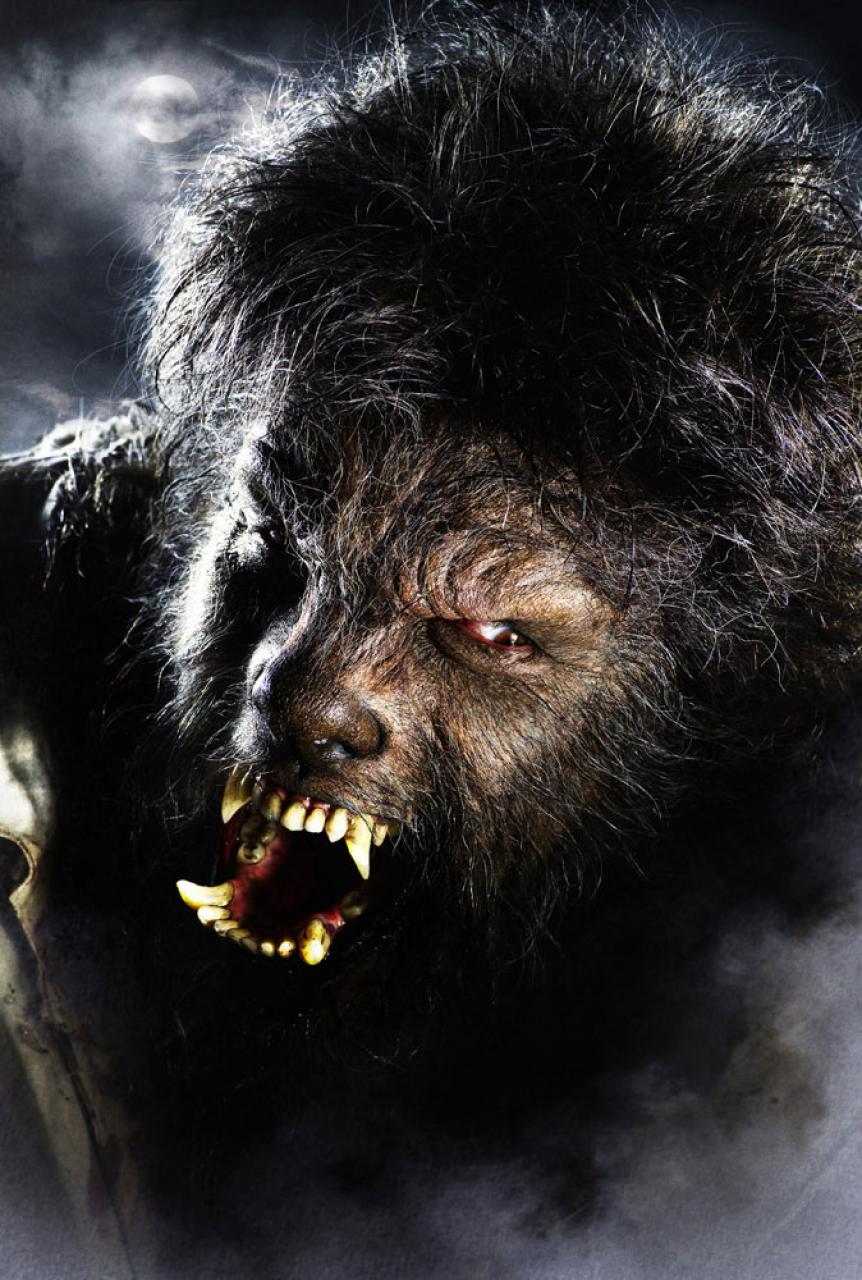
The creature looks way cooler in this promotional still than he ever does in action.

As for the creature itself, I applaud the idea of making the wolfman look like an updated version of Lon Chaney Jr.'s original monster. Problem is, in practice, the monster just looked kind of silly. Despite all the screaming, severed body parts, action footage and gallons of stage blood, this Wolfman is a varsity jacket away from looking like Teen Wolf. Not scary. Every time he roared or howled, I winced, because for all the noble intentions of paying homage to the classic, the wolfman looked... stupid. It is a real shame, because when we can barely see the monster, it looks kind of cool, but the entire last bit of the film has the creature posing, snarling and severing limbs in the center of the screen. I was a little embarrassed for the filmmakers by the end of it all, as it took itself too seriously to even get filed under “campy, but stupid fun.”

I can't really recommend this to anyone. The best scenes were shot in a vacuum, the plot makes no sense and the object and focus of the movie looks ridiculous. When it isn't being ludicrous, it is being boring instead, as there is no sense of pacing or flow throughout the film as a whole. Honestly, go back, watch the original with Lon Chaney Jr., Claude Rains and Bela Lugosi and try to pretend that they never wasted anyone's time or money with this worthless remake. You'll be happier.
Best Blogger Tips
  • Stumble This Post
  • Save Tis Post To Delicious
  • Share On Reddit
  • Fave On Technorati
  • Buzz This Post
  • Tweet This Post
  • Digg This Post
  • Share On Facebook
Blog Gadgets

Monday, August 22, 2011

Build a Better GM Challenge - Unemployed Geek Edition.

Today's article is in response to a challenge posted over at Hill Cantons to RPG Bloggers, to detail three things that those of us who write about tabletop roleplaying games do well as Gamemasters in our home campaigns. While this blog isn't an “RPG blog,” per se, one of the topics I write about with some frequency is the tabletop RPG. One of the goals of this challenge is to share knowledge and insight in a sort of collective “workshop” for people trying to sharpen their skills with regard to running a game for others. So, in order to present my entry to “Build a Better GM,” I'll share a few things that I have learned over the years. Gamemasters are part narrator, part referee, and in most systems the ultimate arbiter of the world and how the characters the players have created can interact with it. Good GMs provide the players with an arena for drama and set the stage for telling their own adventures. Bad GMs enter into a competition with the players, one rigged in their favor. Everyone who runs games has their own strengths, and weak points, and some of the things that make the greatest GMs are talents, that cannot be taught. Others, however, are teachable and learnable skills.

Besides, we all know this guy is the TRUE master.

1. The Balance.

The first thing that I feel I do well in my home campaigns is careful attention to a balance between two elements of gaming that sometimes interfere with each other. The “roleplaying” and the “game.” I've been a player in campaigns where one is emphasized to the neglect of the other, and personally, those sorts of games aren't fun for me. Taking either element to its logical extreme conclusion and you have something that most people wouldn't find fun. All game, no roleplaying sacrifices theme and story for tactical combats without context or meaning, die rolls determine life or death, effective tactics minimize risk and there is a simulation-level resource management. If a “character” dies, it doesn't matter, roll a new one and get back in there. All roleplaying and no game makes character decisions only meaningful in the context of interpersonal relationships. Combats are loosely scripted affairs with no reasonable risk of death unless the player is clearly choosing to make a noble sacrifice, and a trip into town may involve hours of conversations with shopkeepers and locals, making the game more an exercise in collaborative improvised storytelling.

Yes, GMs have Godlike power in their game. Abuse them, and players may "vote with their feet."

The first example is how many of the first tabletop roleplayers played, evoking the wargaming roots of the hobby, and the second is the rule for online forum roleplay. I do not mean to say either of these styles are worthless or that one is inherently superior to the other. It isn't a choice of one extreme vs the other, with the very best gamemasters, a blend and balance of the two has created the best gaming experiences of my life, and I strive to pass that on to players. In general, I make combats meaningful by making the vast majority of my rolls behind the screen stand, and if I need to fudge a roll, I do so very rarely and without letting the players know. I fudge rolls if and only if allowing random chance to stand “as rolled” would make the experience less fun for everyone. A spectacular critical hit from a nameless henchman putting a hero into an early grave scenes before he confronts his personal nemesis might be fudged, but ignoring dice rolls too often makes them all meaningless. Don't be the GM who bends rules to pound the PCs into the dirt, and bends them again to let them win. Players know when you are doing that, and resent it.

2. Roleplaying is a Group Activity.

I've been in a lot of games where there's that one player who insists on creating an obstinate character whose personal goals and outlook frequently cause chaos and dysfunction within the team of other players. I've seen GMs throw their hands up in frustration, not knowing what to do, and a table full of uncomfortable players. After all, the player is “just playing my character, doing what he would do,” so no one can fault him for it, right? Bad advice in this situation labels this individual as a problem player off the bat and recommends eventually asking the player to leave the group. Sometimes, this is regrettably the case, but I've found that such extreme measures are rarely necessary. I've corrected this with a particular speech I give at the beginning of most of my campaigns. The “Group Activity” speech has been given so many times that my regulars don't even need it anymore. It is understood.

The group is a mercenary unit of gritty bounty hunters? Excellent.
My character for this campaign will be... a pacifist.

Basically, I concede that no one can fault someone for playing a character honestly and accurately to their core concept. However, fault can be found in the creation of a character whose outlook and goals will inevitably create conflict and strife, and whose personal philosophy allows for no growth as a person, compromise or change. Roleplaying is a group activity, and the fun for a single player of creating a situation that is all about a clash of their characters personal ideology and goals with the rest of the group should not trump the fun for the other players in that group. An understanding that conflicts within a team may naturally arise as characters develop is one thing, and can provide great scenes if played by mature players resolving a difference of opinion. Making a character who is unsuited philosophically or psychologically to belong to a group working toward a goal is not appropriate for a group activity such are roleplaying in all but the rarest of circumstances. Players in my games keep that in mind before the first word or number is written on a character sheet.

3. Plan to Improvise.

“No plan survives first contact with the enemy.” Every GM who has assumed players would go a certain direction and they immediately seized on the opposite one knows this. Some respond by railroading the players and seizing the illusion of control of their own destinies from the player's hands. This is not fun. One of the strengths of tabletop roleplaying is being able to determine your character's fate, and do what you want, rather than following someone else's script. Knowing that the players will knock you for a loop now and again, a lot of preparatory work can be done to shore up an individual gamemaster's improvisational weaknesses. I have a list of names ready that are unsassigned to any NPC so when they introduce themselves to a throwaway NPC I create on the spot, they don't immediately know that character is unimportant as I struggle for a name off the top of my head.

You want to... talk to the goblin? Okay... His name is... erm... "Bob...lin."

So long as the player group has a concrete goal to work toward to avoid a paradox of choice, and whatever a GM might need to make up, but would personally struggle with on the spot is prepared in advance, there is a lot of fun to be had with letting the players have some control over the flow of the action. Have a few villains statted out, maybe a few maps of locations to be dropped in ready, focus on having the hard stuff to make up on the fly in front of you, and making up the rest by the seat of your pants is easy, and a lot of fun. The limits imposed by a prewritten scenario are gone, and the story can flow purely based on reactions to player decisions.

Whew. This one turned out to be longer than I thought it'd be. I'll refer anyone following these threads for the “Build a Better GM” Workshop back to the links at Hill Cantons, and I also recommend reading articles over at Gnome Stew, and the books Robin's Laws of Good Gamemastering, and Nightmares of Mine, by Kenneth Hite (if you can find an affordable copy, it is the finest advice available to horror GMs.)

Best Blogger Tips
  • Stumble This Post
  • Save Tis Post To Delicious
  • Share On Reddit
  • Fave On Technorati
  • Buzz This Post
  • Tweet This Post
  • Digg This Post
  • Share On Facebook
Blog Gadgets

Friday, August 19, 2011

(Ultimate) Spiderman in the News: Much Ado About Nothing.


Comic books have been in the news a lot lately, and all too often, this is as a result of the convergence of our politically polarized society and popular culture, as I wrote about during the “Superman renounces US citizenship” hullabaloo. The latest round in all this centers on an event that the majority of comic book fans seem to care less about, but has appeared on the evening news and in articles written all across the web and old media. This is the biggest story that doesn't really matter to anyone in the geek world. I am, of course, talking about the death of Spiderman and his replacement by a young teen of mixed african-american and latino descent. On its surface, it seems like this is a big story. One of the most popular characters in comics is killed off, and his identity and costume is picked up by a new person.

Miles Morales, the new face of Spider-Man and scourge of racists who don't read comic books anyway. There may be instances of forced "political correctness" worth getting mad about. This ain't one of 'em.

Fact is, most of us couldn't be bothered to care. Most of the people making a big deal of the whole “death and replacement of Spider-Man thing” aren't comic fans. You can tell because there's no mention of the most important word in the whole fiasco. That word is “Ultimate.” The Ultimate Marvel Universe is an alternate, parallel universe unaffected by and that itself does not effect Core Marvel Universe Canon. What this means to non-geeks is that Marvel Ultimates stories are set in a world that by design have no association with the original visions of the characters, their comic books, their stories. Characters in the Ultimate Universe change appearance, origin, powers and personality, and some of the changes are there to “update” characters, while others seem frustratingly arbitrary.

The idea behind the Marvel Ultimates line is essentially the same reasoning behind this fall's massive DC relaunch/reboot. After decades of history and complex plots, comic books were deemed too intimidating to attract significant numbers of new readers. No influx of new fans, younger people with changing expectations and without the jaded grumbling common to older fans means inevitable attrition. Old fans get frustrated and stop collecting, or as years pass, simply die, and there is no generation waiting in the wings to replace them. Too many young people don't want to jump in on the middle of a story, and as a result, potential converts of kids who saw various Marvel Universe movies are opportunities wasted. This is the logic behind the creation of a 2nd Marvel Universe. The blank slate, lack of established canon that needs to be followed and enthusiasm for new creators to tell stories with familiar characters in their own way on its surface makes a lot of sense.

"Updated" art and costumes, redesigned characters and Colossus is gay!
With jokes about "Will and Grace," the hamfisted portrayal of the gay superhero would offend everyone...
If anyone cared.

Thing is, most comic geeks today hate Ultimates and couldn't care less about whatever happens in it. In the early launch (2000-2005) of the Ultimate Titles, they sold like crazy. Traditional, “core” Marvel books were dying on the vine, and the idea of a relaunch seemed to be a runaway success. Several popular video games tied in nicely with the new setting, and it didn't hurt that Marvel Ultimate Alliance (and its sequel) were really good fighting games with RPG elements. The new wave of Marvel films plays it real close to the vest on which canon they are a part of, incorporating just enough from each Universe to satisfy fans of either. The problem is, the Ultimate Marvel books themselves had a crisis of identity. Having already alienated fans who didn't like certain characters seemingly randomly changed from their classic characterizations, new fans were slowly turned off when the writers who launched the new line in the first place left to work on “core” titles.

The energy once brought to Ultimates brought new life into previously slumped comic books, and the Ultimate Universe responded by borrowing more and more from the core continuity. Core and Ultimate Marvel were each starting to look like each other, and the Ultimate books did not benefit from the comparison, or the change in philosophy. To the uninitiated, Marvel comics appeared schizophrenic, and the Ultimate titles got the worst end of it, in addition to the lion's share of the blame. Fast forwarding to present day, core Marvel titles outsell their Ultimate equivalents, and with film and game tie-ins, the brand appears healthy again. In order to keep both lines relevant, Ultimates had to get back to what made people like it in the first place. It had to be more “different.” In this context, new writer Jeph Loeb interpreted “different” as “kill everybody.”

"Relaunch it again! Kill more heroes! See! We have characters from popular movies!
Love us again! LOVE US!!! *sob*"

The last few years have been marked by so many catastrophic events and character deaths that most of the remaining few who hadn't already thrown their hands up and given up on Ultimates threw in the towel. Titles that owed their success to failing books in the mainstream continuity resorted to increasingly desperate-seeming tactics to remain relevant. This is why when word came down that Peter Parker was being killed off the reaction went something like this: “What? Oh, Ultimate Spider-Man... I'll go back to not caring now.” Sales spike every time these cries for attention hit the shelves, but it seems that no matter how many popular characters are killed, a few issues later, sales are down again, and most comic book fans are happily ignorant of the happenings in the Ultimate continuity.

This is why this is such a non-issue. So what if the new Ultimate Spider-Man is a minority? Nick Fury has been Samuel L. Jackson with an eyepatch for over a decade in that world. The chest-thumping from conservative politicians and pundits make a whole lot of noise about it, with vaguely racist undertones, and most comic book fans are thinking: “What? Who? You think this matters? That's not even funny, it is kind of sad...” There's a story here, but it is a story that is aimed at people who couldn't care less about comics, because to the vast majority of the people who do care about comic books, there is no story here. Political commentators have taken up arms to defend... well, no one. The fact that so much (including this article) has been written and said on a subject that matters to so few says less about the comic book industry, and more about how disconnected politicians and cultural commentators have become from the rest of the population.
Best Blogger Tips
  • Stumble This Post
  • Save Tis Post To Delicious
  • Share On Reddit
  • Fave On Technorati
  • Buzz This Post
  • Tweet This Post
  • Digg This Post
  • Share On Facebook
Blog Gadgets

Thursday, August 18, 2011

Domain is the Name of the Game – Kingdoms and Towns in RPGs


I've always been fascinated by the concept of community building in roleplaying games. I'm not talking about building a community of players, though I've certainly been through all that in the last two decades. I'm talking about the incorporation of elements traditionally left to strategy computer games like Civilization into the tabletop rpg. Early editions of D&D had sketchy notes on the concepts of followers and strongholds, indicating that a transition to a position of rulership over a kingdom was a goal of high level play. My personal largest design project was the initial structure and mechanics for the Living Greyhawk Town Project. Written for the Living Campaign's Illinois and Indiana region of the Viscounty of Verbobonc initially, long after development of my rules passed from my hands, the system spread. Before long, players nationwide were sinking character gold and personal creativity into building and growing a village for PCs and NPCs to call home. The notion of domain-level play continues to fascinate me, and the inspiration for a flurry of design has eluded me since I wrote most of the Town Building rules in a single feverish night.

Screenshot from Majesty 2. I kind of want to do this, only not limited to fantasy, and in a Tabletop RPG.

What is domain play? Simply put, it is characters in control of something larger than their personal characters and a small group of henchmen. Whether that means a town, a kingdom, a temple, guild or street gang, there are events that must be endured and responded to, resources to be collected and power structures to be built. One of the most well known examples of domain play is the AD&D Birthright Campaign setting, which was interesting on its surface, but failed to catch on, as suiting the management of a kingdom to individual play groups felt unwieldy. It almost felt as though Birthright was two games, one a strategic solo play that felt almost like a board game, and another that cobbled the rulers of the local kingdom, temple, wizard's guild and thieves guild to adventure together somehow. DMs were confused by how, specifically to structure the narrative of their campaign to have both the dungeon exploration and roleplaying mix with the micromanagement and politics of the domain turn.

Domain gaming isn't unique to Dungeons and Dragons, either. The Lodge rules in the Savage Worlds setting Rippers that I recently wrote about are a very abstract and simple example of this style of gaming. TORG had a set of mechanics for player controlled megacorporations competing in economic warfare with hostile takeovers, market manipulation and stock splits that most likely only interested a tiny sliver of gamers that includes me. I'm fascinated by the idea of a system that incorporates gathering of materials, building defenses and infrastructure and establishing trade to watch a player-built organization flourish. Every rule set I've encountered has either been too abstract and mechanically murky, or has otherwise seemed half-finished. The best of these rules have been complicated, requiring a lot of bookkeeping and end up feeling like a separate game that is tacked on to an RPG.

I've met so many people who read and loved the idea of this boxed set.
No one who actually played it.

There are some examples of domain play in more recent gaming systems, but I know only enough about them to list them here. Green Ronin's A Song of Ice and Fire RPG, based on Martin's books includes rules on managing a character's own House in the Game of Thrones, an essential aspect of the setting, in my opinion. Goodman Games also recently published the D&D 4th Edition supplement Crime Pays, which handles a fantasy take on running criminal organizations. What little I've gotten to see from Crime Pays amounts to a pretty decent little set of rules for managing anything from a street gang through a thieves' guild or a player-controlled Mafia complete with bribing officials, assigning specific crimes and getting involved in wars for territory. I'm currently grappling with whether or not I need to add this to my collection of domain gaming books I am unlikely to use, but which I really like the idea of.

Smaller publishers and fan-supported projects have gotten into the act as well, with standouts being Greg Stoltze's REIGN system for the ORE (One Roll Engine) system, available as either print-on-demand or downloadable PDF with a pile of supplements licensed under Creative Commons ready to download from his website. The strength of the Reign system is in random generation of power groups with conflicting goals and a streamlined system for resolving conflicts between them. Currently under production and in beta-testing is the Borderlands domain game for D&D OSR (Old-School Rules) being written and refined over at the blog Hill Cantons. I've seen the preview of the Table of Contents, and I'm looking forward to checking out the finished product when it is ready for public consumption beyond those few lucky groups who can commit to a full playtest.

I recommend looking into the setting and deciding if the setting info is necessary for
your game if you want to try this, otherwise there is a cheaper edition without it out there.

I still daydream about being able to run a game where city construction and management is as integral to the play as delving into dungeons and trade, diplomacy and resource management have to be mastered as well as the sword. I'd love to play a tabletop RPG where the management of an organization works without endless charts and bookkeeping. Maybe one of the existing systems I haven't tried or don't know about will fill this need to mashup computer strategy gaming with my tabletop roleplaying. Maybe not. I was pretty much the perfect target audience for the indie RPG Recettear, imported from Japan on Steam and focusing on running an item shop in a little fantasy village. I still load up and play X-Com: UFO Defense and Jagged Alliance. I'd just like a little more building bases, running guilds, expanding the territory of my character's street gang and successfully building a community in my games. Anyone know how?
Best Blogger Tips
  • Stumble This Post
  • Save Tis Post To Delicious
  • Share On Reddit
  • Fave On Technorati
  • Buzz This Post
  • Tweet This Post
  • Digg This Post
  • Share On Facebook
Blog Gadgets